Wednesday
Wednesday: Loft Lab, Rectangle Puzzles
Comet sets four envelopes on the bench, each with tiles inside and a polynomial on the front. "Lab day. Slide, don't calculate."
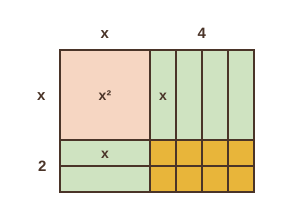
Wren opens the first: x² + 6x + 8. He slides the eight units into a 2 by 4 block and fits the strips. "x + 2 by x + 4."
The second takes longer. Twelve units could be 1 by 12, 2 by 6 or 3 by 4. Only one block lets seven strips fit.
Nova hovers over a fifth envelope marked x squared plus 5x plus 7. "Would you like a hint? Try every corner for the seven units."
"1 by 7 needs 8 strips. There are only 5," Comet says after a while. "This one cannot make a rectangle at all."
"Not every polynomial factors," Wren says. "The tiles just told us. Our engineer, solve all four envelopes and log them."
What you need
- Your cardboard tiles from last week: at least 1 x² tile, 8 strips and 12 unit squares.
- Four envelopes or folded cards, each labeled with one polynomial from the lab log below.
- Your Loft Log, a pencil, and a flat surface with room to slide.
Keep tiles on the table, not the floor, so nobody slips.
Scissors stay closed and put away while you build.
Run the lab
- Open one envelope and count the tiles of each kind. Check the count against the polynomial.
- Arrange the unit tiles as a rectangular corner. Try each possible corner shape.
- Fit the strips along the two sides of the x² tile so the corner closes the rectangle.
- Read the sides as x plus a number each. Write the factored form.
- Multiply the factored form back on paper and compare with the envelope.
- If no corner works, record that the polynomial does not factor, and say what went wrong.
The crew's lab log
The four envelopes the crew solved, with their tile counts. Every count is the crew's own.
| Polynomial | x² tiles | Strips | Units | Sides |
|---|---|---|---|---|
| x² + 6x + 8 | 1 | 6 | 8 | x + 2 and x + 4 |
| x² + 7x + 12 | 1 | 7 | 12 | x + 3 and x + 4 |
| x² + 5x + 4 | 1 | 5 | 4 | ? |
| x² + 4x + 4 | 1 | 4 | 4 | ? |
- Read the question.
- Tap your answer.
Which is the factored form of x² + 6x + 8?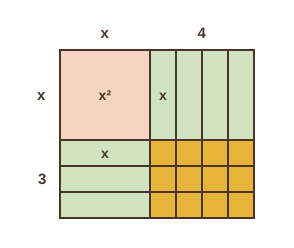 Which is the factored form of x² + 7x + 12?
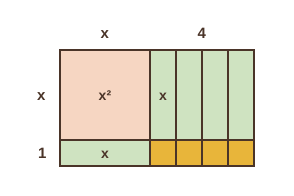 Which is the factored form of x² + 5x + 4?
| Statement | True or false? |
|---|---|
| x² + 6x + 8 = (x + 2)(x + 4) | ? |
| x² + 7x + 12 = (x + 3)(x + 4) | ? |
| x² + 5x + 4 = (x + 2)(x + 2) | ? |
| The tiles for x² + 5x + 7 can be slid into a rectangle. | ? |
| Twelve units can form a corner in three different ways: 1 by 12, 2 by 6 or 3 by 4. | ? |
Hand it to someone else to slide back into a rectangle. Check their sides against yours.
Patient sliding. Tomorrow factoring finds where the crew's cardboard arch meets the table, and a rough graph follows.