Thursday
Thursday: Zeros and a Rough Graph
Comet bends a cardboard strip into an arch for the fair sign and tapes its feet down.
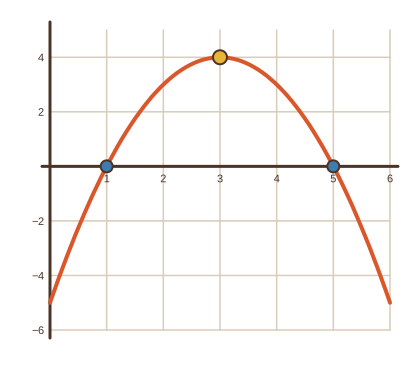
"Nova fitted a rule to it," Wren says. "Height y equals -x² + 6x - 5, with x in hand widths along the table. Our own model."
"Where does it touch the table?" Comet asks. "Height zero. So I set the rule to zero and solve."
"Factor it," Wren says. "What do you notice?" The factored form reads -(x - 5)(x - 1).
"Zero when x is 1 or x is 5," Comet says. "Those are the feet. And the top is halfway, at x equals 3."
Nova hovers above the arch, her light tracing the curve. "Would you like a hint? Three points make a rough graph."
"Two zeros and the point in the middle," Wren says. "Our engineer, find the height at the middle and sketch the arch."
Zeros from the factored form
A zero of a polynomial is an input that makes it zero. A product is zero only when one of its factors is zero.
The arch rule -x² + 6x - 5 factors as -(x - 5)(x - 1). The factor x - 1 is zero at x = 1, and x - 5 is zero at x = 5.
So the zeros are 1 and 5: the arch meets the table 1 hand width in and 5 hand widths in.
Between the zeros the arch is highest at the midpoint, x = 3, where the height is 4.
The crew's arch table
The crew's model values along the table, computed from their rule. Their rule, their numbers.
| x (hand widths) | y = -x² + 6x - 5 | Above or below the table? |
|---|---|---|
| 0 | -5 | below |
| 1 | 0 | on the table |
| 2 | ? | above |
| 3 | 4 | above |
| 4 | ? | above |
| 5 | 0 | on the table |
| 6 | -5 | below |
- Factor the polynomial and read the zeros.
- Mark the zeros on the x-axis.
- Find the midpoint between the zeros and work out the height there.
- Draw a smooth curve through the three points, opening down if the x² term is negative.
- Read the question.
- Tap your answer.
- Read the question.
- Tap your answer.
| Statement | True or false? |
|---|---|
| x = 1 is a zero of -x² + 6x - 5. | ? |
| x = 3 is a zero of -x² + 6x - 5. | ? |
| x = 4 is a zero of x² - 6x + 8. | ? |
| A product of two factors is zero only when at least one factor is zero. | ? |
| The factored form of a quadratic shows its zeros directly. | ? |
Sharp sketching. Tomorrow you choose the form of an expression that tells you what you need to know, then review the week.