Wednesday
Wednesday: Loft Lab, the Bouncing Ball
Comet tapes the tape measure up the door frame, zero at the floor. "Lab day. The ball drops from 100 centimeters."
Wren crouches with his eyes level with the mark. "Bounce one, about 81. Drop it again from 81."
"Sixty-three," he calls on the next drop. Then, "Fifty-two." Then, "Forty."
"The drop is shrinking," Comet says. "By 19, then 18, then 11, then 12. That is not a steady subtraction."
Nova hovers beside the numbers, her light pairing each height with the one before. "Would you like a hint? Divide instead."
"81 over 100 is about 0.8. 63 over 81, about 0.8 again," Wren says. "It keeps about four fifths each bounce."
"A decay factor," Comet says. "Our engineer, write the rule and tell us what bounce five should be."
What you need
- A rubber ball that bounces well on a hard floor.
- A tape measure or meter stick taped upright to a wall or door frame, zero at the floor.
- A partner to watch the bounce peak at eye level, and your Loft Log.
- Clear floor space with nothing breakable nearby.
Drop the ball, never throw it. Keep shoes on and watch for the ball rolling underfoot.
A grown-up knows you are bouncing a ball indoors and says where it is fine to do it.
Run the lab
- Hold the ball so its bottom is at the 100 centimeter mark. Let it drop.
- Your partner reads the height of the first bounce peak. Record it as drop 1.
- Drop the ball from that new height. Record the next bounce peak as drop 2.
- Repeat until the bounce is too small to read well, at least four drops.
- Divide each height by the one before it. Write the ratios in your table.
- Pick the factor the ratios cluster around. Write the model: 100 × factor to the power n.
The crew's lab log
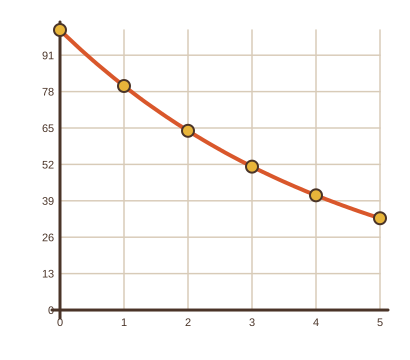
Here are the crew's Wednesday heights, read by eye against the tape. They are the crew's own measurements, rounded to the centimeter.
The ratios cluster near 0.8, so the crew's model is h(n) = 100 × 0.8n. The model and the measurements do not agree exactly, and that is normal.
| Drop n | Measured height (cm) | Model 100 × 0.8^n |
|---|---|---|
| 0 | 100 | 100 |
| 1 | 81 | 80 |
| 2 | 63 | 64 |
| 3 | 52 | ? |
| 4 | 40 | ? |
- Read the question.
- Tap your answer.
| Statement | True or false? |
|---|---|
| The heights drop by the same number of centimeters each bounce. | ? |
| The heights are multiplied by about the same factor each bounce. | ? |
| 100 × 0.8 = 80 | ? |
| 80 × 0.8 = 64 | ? |
| A decay factor is a growth factor that is less than 1. | ? |
Predict drop 6 with your model before you measure it. Then measure and compare.
Careful measuring. Tomorrow the crew races a doubling strip against a stack that only adds, and watches the strip win.