Thursday
Thursday: The Race the Doubling Wins
Comet stacks cardboard squares on the bench, eight more at every step. "My stack adds 8 each time. Steady and fast."
Wren folds a strip beside it. "My strip doubles. Slow start, one layer, then two, then four."
"I am ahead by a mile," Comet says at step three. "Twenty-four to your eight."
Nova projects a table above the bench with a third column, a square pad that grows n by n. "Would you like a hint? Keep going."
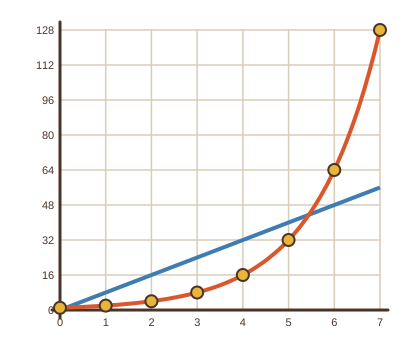
Step four, 32 to 16. Step five, 40 to 32. Step six, 48 to 64. Comet stares. "You passed me."
"And I stay ahead now," Wren says. "Doubling beats adding. It beats squaring too, from step five on."
"Our engineer," Comet says, "find the exact step where the strip passes each column. Then tell me why it never falls behind again."
Three ways to grow
The crew's race table has three columns, all made up for the Loft and all starting small.
Comet's stack is linear: 8n squares at step n. The square pad is quadratic: n times n squares.
Wren's strip is exponential: 2n layers. It starts slowest and ends far ahead.
An exponential function multiplies every step. Sooner or later each multiplication adds more than any fixed step can.
| Step n | Stack 8n | Square n × n | Strip 2^n |
|---|---|---|---|
| 0 | 0 | 0 | 1 |
| 1 | 8 | 1 | 2 |
| 2 | 16 | 4 | 4 |
| 3 | 24 | 9 | 8 |
| 4 | 32 | 16 | 16 |
| 5 | 40 | 25 | 32 |
| 6 | 48 | 36 | ? |
| 7 | 56 | 49 | ? |
Reading the race
- The strip stays ahead of the stack from step 6 on. At step 6 it has 64 layers against 48 squares.
- The strip stays ahead of the square pad from step 5 on: 32 against 25.
- Once ahead, it stays ahead. Doubling a bigger number adds more than doubling a smaller one, and more than adding 8.
- Read the question.
- Tap your answer.
- Read the question.
- Tap your answer.
| Statement | True or false? |
|---|---|
| At step 3 the stack is ahead of the strip. | ? |
| At step 6 the stack is ahead of the strip. | ? |
| At step 4 the strip and the square pad are tied. | ? |
| 2 × 2 × 2 × 2 × 2 × 2 = 64 | ? |
| An exponential function with factor 2 eventually passes any linear function. | ? |
Record both counts for six steps. Mark the step where the doubling pile takes the lead for good.
Sharp table reading. Tomorrow percent changes hide inside growth factors, and the crew learns to read a rate off a rule.