Tuesday
Tuesday: Rules From Two Readings
Comet props the clear jug under a tube and opens the clip. Water drips in. "Timing from now."
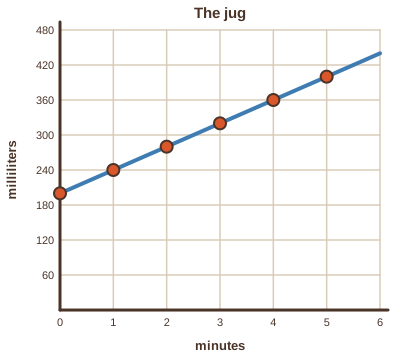
Wren reads the side at 2 minutes. "280 milliliters." At 5 minutes: "400."
"We missed the start," Comet says. "Can we still get the rule? What can we make from two readings?"
"Two points," Wren says. "(2, 280) and (5, 400). What do you notice? 120 milliliters in 3 minutes."
"Forty a minute." Comet counts back. "Two minutes before the first reading takes away 80. So it started at 200."
Nova projects the line through both points. "Would you like a hint? Say what the 40 and the 200 mean."
"Forty is the drip rate. Two hundred was already in the jug," Wren says. "V = 40t + 200."
"Our engineer, build the next rule from the table," Comet says.
From two input-output pairs
- Write the two pairs as points (input, output).
- Rate: change in output divided by change in input.
- Start: go back from one point to input 0 using the rate, or solve b = output - rate × input.
- Write y = rate × input + start, and check both points in it.
Jug: (2, 280) and (5, 400). Rate 40 milliliters a minute. Start 200. So V = 40t + 200.
The slope is the rate the jug fills. The intercept is how much water was there when the timing began.
From a table
A table is linear when equal steps in the input give equal steps in the output. Check the differences first.
If they are all the same, that difference is the rate. Then find the start the same way as before.
If the differences change, the table is not linear, and a line would be the wrong model.
| Minutes (t) | Jug A (milliliters) | Jug B (milliliters) | Differences, A |
|---|---|---|---|
| 0 | 200 | 150 | |
| 1 | 240 | 170 | +40 |
| 2 | 280 | 210 | +40 |
| 3 | 320 | 270 | +40 |
| 4 | 360 | 350 | +40 |
Two ways to the same rule
Way one: rate first, then step back to the start. Way two: write y = mx + b, put in the rate and one point, solve for b.
Jug, way two: 280 = 40 × 2 + b, so b = 200. Same rule. Use whichever feels clearer, and check with the other point.
- Read the question.
- Tap your answer.
- Read the question.
- Tap your answer.
- Read the question.
- Tap your answer.
- ?Step back to t = 0: 280 - 2 × 40 = 200
- ?Find the rate: (400 - 280) ÷ (5 - 2) = 40
- ?Check the second point: 40 × 5 + 200 = 400
- ?Write the rule: V = 40t + 200
| Statement | True or false? |
|---|---|
| Two input-output pairs are enough to find a linear rule. | ? |
| In V = 40t + 200, the jug held 40 milliliters at the start. | ? |
| Equal input steps with equal output differences mean the table is linear. | ? |
| Jug B, 150, 170, 210, 270, is linear. | ? |
| 40 × 5 + 200 = 400 | ? |
| (400 - 280) ÷ (5 - 2) = 40 | ? |
Now try two rows from jug B. Why does the rule fail to match the other rows?
Excellent modeling. Tomorrow is Loft Lab: you stack the tower and time the jug yourself.