Monday
Monday: Cups, Rows and a Rule
Comet dumps a bag of paper cups on the Loft floor. "Fair-day tower. Three cups a row, and one flag cup on top."
Wren stacks the first row and sets the flag cup above it. "Four cups. Now add a row."
"Seven," Comet says. Another row. "Ten. Thirteen." She stops. "What can we make of that?"
"What do you notice?" Wren asks. "Each row adds three. So the count is 3 times the rows, plus 1."
Nova hovers over the stack and projects the list: 4, 7, 10, 13. "Would you like a hint? Those are terms."
"Terms of a sequence," Wren says. "Term 1 is 4. Term 2 is 7. Term n is 3n + 1."
"Then I can plan the whole tower before I stack it," Comet says. "Our engineer, how many cups for 10 rows?"

A rule from a situation
A situation with a steady change makes a linear rule. Name the input and the output first.
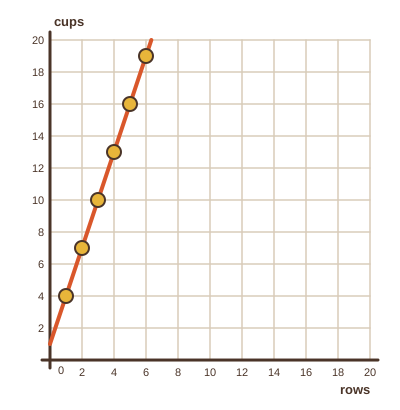
Tower: input n is the number of rows, output a(n) is the cups used. Each row adds 3 and the flag adds 1, so a(n) = 3n + 1.
The 3 is the rate: 3 cups per row. The 1 is the extra cup that does not depend on rows.
| Rows (n) | Cups a(n) |
|---|---|
| 1 | 4 |
| 2 | 7 |
| 3 | 10 |
| 4 | 13 |
| 5 | 16 |
| 6 | 19 |
A sequence is a function
The list 4, 7, 10, 13, 16, ... is a sequence. Term n is a function of n, and n is a whole number: 1, 2, 3 and so on.
You cannot build 2.5 rows, so the domain is the counting numbers. The graph is dots on a line, never the whole line.
Recursive rule: a(1) = 4, a(n) = a(n - 1) + 3. Explicit rule: a(n) = 3n + 1. Both describe the same tower.
A solved problem to study
Comet wants the cups for 10 rows. Recursive way: 4, 7, 10, 13, 16, 19, 22, 25, 28, 31. Ten steps of adding 3.
Explicit way: a(10) = 3 × 10 + 1 = 31. One multiplication and one addition.
Both give 31. The recursive rule shows the pattern, the explicit rule jumps straight to any term.
- Read the question.
- Tap your answer.
- Read the question.
- Tap your answer.
| Statement | True or false? |
|---|---|
| Term 1 of the tower sequence is 4. | ? |
| The input n of the tower sequence can be any decimal. | ? |
| In the sequence starting 4 and adding 3, term 6 is 19. | ? |
| In the sequence starting 4 and adding 3, term 9 is 27. | ? |
| 3 × 10 + 1 = 31 | ? |
Stack on the floor, never on a chair, and keep the tower below your shoulders.
Great start, engineer. Tomorrow you build rules from two readings and from a table, and learn what each number means.