Monday
Monday: The Cart Draws a Line
Comet sets the plank on two sawhorses, barely tilted. "Gentle slope. The cart should roll nice and steady."
Wren has taped marks along the plank every 10 centimeters. "I call out the mark each second. You write."
Comet lets go. "One mark. Four. Seven. Ten. Thirteen." The cart rolls off the end into a towel.
"What do you notice?" Wren asks, reading the list.
"It goes up by three every second," Comet says. "Three marks a second. But it started at mark one, not zero."
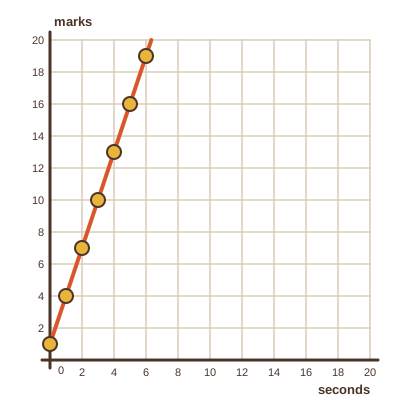
Nova hovers above the notebook and projects the numbers as dots. They sit in a perfect straight line.
"Would you like a hint?" she asks. "Three per second and a start of one. You wrote a rule like that last week."
"d = 3t + 1," Comet says. "Our engineer, help us read it as a graph."

From readings to a rule
The crew's readings are their own Monday timings on the gentle plank. Each second the cart passes 3 more marks.
At t seconds the cart is at d = 3t + 1 marks. A mark is 10 centimeters, so in centimeters d = 30t + 10.
The 3 is the rate of change: 3 marks per second. The 1 is the starting value, the mark at t = 0.
| Seconds (t) | Marks (d = 3t + 1) | Centimeters (30t + 10) |
|---|---|---|
| 0 | 1 | 10 |
| 1 | 4 | 40 |
| 2 | 7 | 70 |
| 3 | 10 | 100 |
| 4 | 13 | 130 |
| 5 | 16 | 160 |
| 6 | 19 | 190 |
A solved problem to study
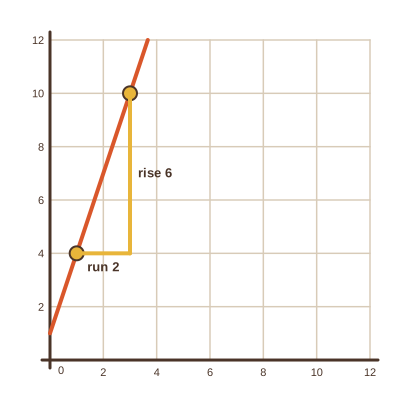
Wren wants the rate of change from two readings only: (1, 4) and (3, 10). Here is his work.
Change in output: 10 - 4 = 6 marks. Change in input: 3 - 1 = 2 seconds. Rate: 6 ÷ 2 = 3 marks per second.
Then the start: going back one second from (1, 4) takes away 3, so d = 1 at t = 0. The rule is d = 3t + 1.
Why does this work? On a line the change per second is the same everywhere, so any two points give the same rate.
- Read the question.
- Tap your answer.
- Read the question.
- Tap your answer.
| Statement | True or false? |
|---|---|
| The rate of change of d = 3t + 1 is 3 marks per second. | ? |
| The y-intercept of d = 3t + 1 is 3. | ? |
| The point (4, 13) is on the graph of y = 3t + 1. | ? |
| The point (5, 15) is on the graph of y = 3t + 1. | ? |
| 10 - 4 = 3 × 2 | ? |
Plot the crew's seven readings from the table and lay a ruler along them. Do they make one straight line?
Strong start, engineer. Tomorrow you graph rules by hand, find both intercepts and meet a line that goes down.