Friday
Friday: Lines Everywhere
Comet drops onto the Loft couch. "Lines are everywhere now. I timed myself walking home: 80 meters a minute."
"Then your distance is a line, d = 80t," Wren says. "What do you notice about its intercept?"
"Zero. I started at the door." She sits up. "And my phone battery. It fell 2 percent every 10 minutes."
"A falling line, like the jug," Wren says. "Write the rule and read where it reaches zero."
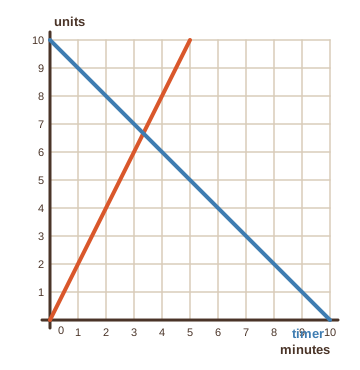
Nova projects a tiny grid with a line sloping down. "Would you like a hint? Minutes across, percent up."
"Start at 100, down 0.2 a minute, so 100 - 0.2t. Zero at 500 minutes," Comet says.
"Review time," Wren says. "Our engineer, five features, every graph. Then next week we build the cup tower."
Lines in a day
- Walking at a steady pace: distance rises by the same amount each minute. Increasing, intercept at the start.
- A battery or a jug draining steadily: decreasing, positive until it reaches zero at the horizontal intercept.
- A kitchen timer counting down: decreasing by 1 each second, reaching zero when it rings.
- Cups stacked at the same height each: increasing, rate equal to one cup's height.
The week in five lines
- A linear function graphs as a straight line. The rate of change is its slope.
- The y-intercept is the output at input 0. The horizontal intercept is where the output is 0.
- Positive slope means increasing. Negative slope means decreasing.
- Graph by hand: axes with labels and a scale, the intercept, one step with the rate, the line.
- Average rate of change over an interval is change in output over change in input, line or not.
- Read the question.
- Tap your answer.
- Read the question.
- Tap your answer.
| Statement | True or false? |
|---|---|
| A negative rate of change means the graph goes down from left to right. | ? |
| The y-intercept of y = 5x - 2 is 5. | ? |
| The graph of y = 12 - 2x crosses the horizontal axis at x = 6. | ? |
| The average rate of change of a line is the same on every interval. | ? |
| The point (2, 160) is on the graph of y = 80t. | ? |
| 100 - 0.2 × 500 = 0 | ? |
Walk, never run, and keep the hallway clear.
Terrific week. You can read, draw and compare linear graphs. Tomorrow is Loft Day.