Tuesday
Tuesday: Function Notation
"Our cart rule from last week," Wren says, writing on the whiteboard. "Distance is 40 centimeters each second."
"So the distance after t seconds is 40t," Comet says. "Let's give the rule a name. Call it d."
"d(t) = 40t," Wren writes. "Read it: d of t equals 40 t. What do you notice about d(3)?"
"Put 3 in for t. 40 times 3. d(3) = 120. Three seconds in, 120 centimeters out."
Nova projects the sentence d(3) = 120 and makes the 3 and the 120 glow in turn. "Would you like a hint? Say it as a story."
"After 3 seconds the cart has gone 120 centimeters," Comet says. "The notation is the story, shortened."
"And the parentheses are not multiplication," Wren adds. "d(3) means d at 3."
Naming the rule
Function notation names a rule and its input together. Write f(x) for the output of f when x goes in.
The cart: d(t) = 40t. Then d(3) = 120, read "d of 3 equals 120". After 3 seconds, 120 centimeters.
The crank box: f(x) = 3x + 2. Then f(3) = 11: 3 goes in and 11 comes out.
The letter in the parentheses is the input. The whole expression f(3) is one number, the output.
| Notation | Read it as | In the Loft |
|---|---|---|
| d(t) = 40t | d of t equals 40 t | the cart's distance after t seconds |
| d(3) = 120 | d of 3 equals 120 | after 3 seconds, the cart has gone 120 centimeters |
| c(r) = 3r + 1 | c of r equals 3 r plus 1 | the cups in a tower with r rows |
| c(5) = 16 | c of 5 equals 16 | a tower with 5 rows uses 16 cups |
Evaluating a function
- Find the input inside the parentheses.
- Replace every copy of the letter in the rule with that input.
- Work it out, powers first, then multiplication, then addition and subtraction.
- Write the result as the output: f(input) = output.
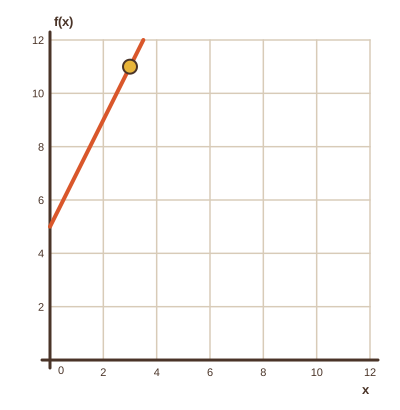
The graph of f is the graph of y = f(x). For f(x) = 2x + 5, the point (3, 11) sits on the line because f(3) = 11.
Reading f(3) from a graph: go to 3 across, up to the line, and read the height.
Two ways to find an output
From the rule: put the input into the expression and compute.
From a table: find the input in the input column and read across.
Both give the same answer when the table came from the rule. The crank box table says 3 gives 11, and so does 3x + 2.
- Read the question.
- Tap your answer.
- Read the question.
- Tap your answer.
| Statement | True or false? |
|---|---|
| f(3) means f multiplied by 3. | ? |
| For d(t) = 40t, d(3) = 120. | ? |
| 3 × 5 + 1 = 16 | ? |
| The point (3, 11) is on the graph of f(x) = 2x + 5. | ? |
| The graph of f is the graph of y = f(x). | ? |
Make a table for inputs 1 to 4 and check that it matches the rule.
Excellent. Tomorrow is Loft Lab: you build a crank box and run cards through it.