Monday
Monday: The Crank Box
Comet sets a cardboard box on the bench. It has a slot on each side and a crank on top. "Function machine."
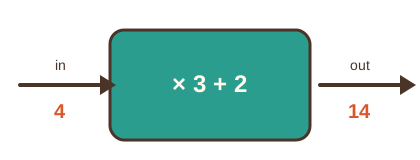
Wren writes 4 on an index card and feeds it into the left slot. Comet turns the crank. A card slides out: 14.
"Rule: multiply by 3, add 2," Comet says. "Try another." Wren feeds in 5. Out comes 17.
"What do you notice?" Wren asks. "Feed in 4 again."
Comet cranks. 14 again. "Same input, same output. Every time."
Nova hovers over the slot, her light tracing the card's path. "Would you like a hint? That is what makes it a function."
"One input, exactly one output," Wren says. "The inputs we allow are the domain. The outputs are the range."

A function gives exactly one output
A function is a rule that takes an input and gives back exactly one output. Feed in the same input twice, get the same output twice.
The crank box's rule is × 3 + 2. Feed in 4 and 14 comes out. Feed in 5 and 17 comes out.
The set of inputs the box accepts is its domain. The set of outputs it gives is its range.
A solved problem to study
Here is how Wren found the range of the crank box for the inputs 1, 2, 3 and 4. Read each step.
- Write the rule as an expression: the output is 3x + 2 when x goes in.
- Put each input in: 1 gives 5, 2 gives 8, 3 gives 11, 4 gives 14.
- The domain is {1, 2, 3, 4}. The range is {5, 8, 11, 14}.
- Check that no input gave two outputs. It is a function.
| Input (x) | Output (3x + 2) |
|---|---|
| 1 | 5 |
| 2 | 8 |
| 3 | 11 |
| 4 | 14 |
| 5 | ? |
When a rule is not a function
Suppose the box gave 14 for one card marked 4 and 20 for the next card marked 4. The same input gave two outputs.
That box is not a function. You could not predict its output, so you could not use it in a build.
A rule can give the same output for two different inputs and still be a function. Only repeated inputs with different outputs break it.
- Read the question.
- Tap your answer.
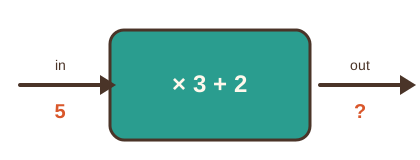 The crank box rule is × 3 + 2. What comes out when 5 goes in?
- Read the question.
- Tap your answer.
| Statement | True or false? |
|---|---|
| A function gives exactly one output for each input. | ? |
| If two different inputs give the same output, the rule is not a function. | ? |
| 3 × 4 + 2 = 14 | ? |
| For the crank box with domain {1, 2, 3, 4}, the range is {5, 8, 11, 14}. | ? |
| The domain is the set of outputs a function gives. | ? |
Write each input and output as a pair. Check that no input gave two outputs.
Strong start. Tomorrow the rule gets a name, and f(3) = 11 tells a story.