Monday
Monday: What a Thunderstorm Is
A tall cloud climbs over the hills beyond Station Rooftop, white on top and gray underneath.
Rocket has his camera out. "Look at it grow! Can we go up and watch?"
Raven checks the sky from the lab window and shakes her head. "What do you notice about the bottom of the cloud?"
"It is getting dark," Rocket says. "And the top is flattening out like an anvil."
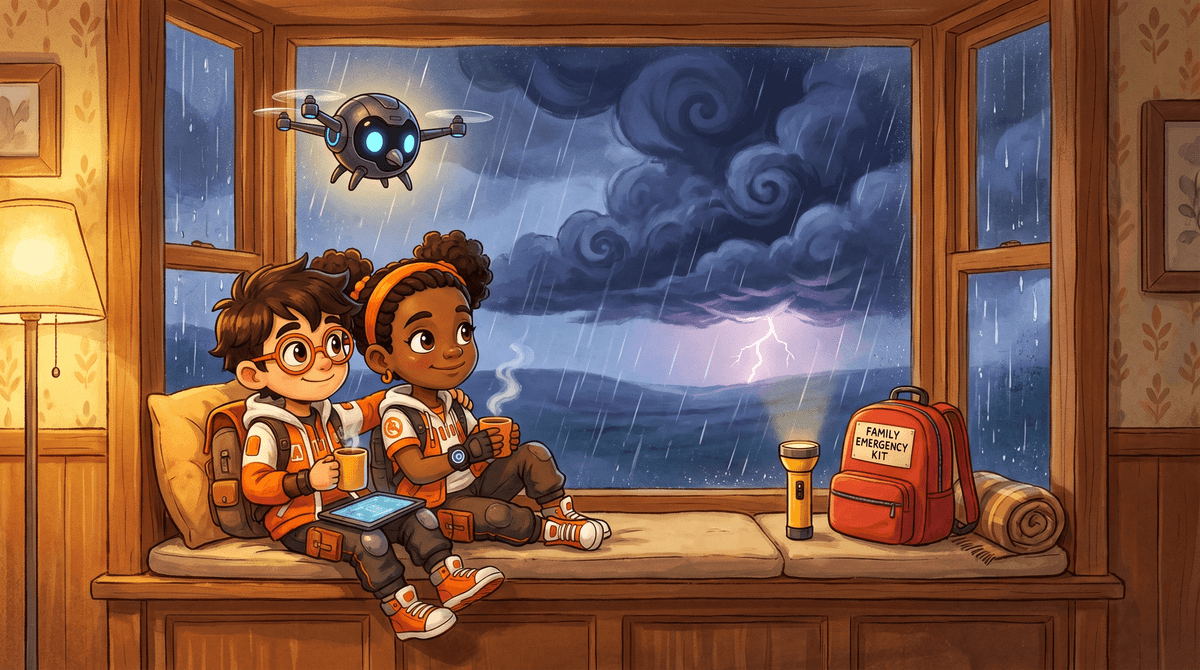
A low rumble rolls across the valley. Nova glides between Rocket and the door.
"That sound means the storm is close enough to matter," she says. "When thunder roars, where do we go?"
"Indoors," Rocket sighs, lowering the camera. "We watch from the window. And we learn how it works."
Three ingredients
A thunderstorm needs three things. First, moisture: oceans are the usual source, and warmer water adds more of it to the air.
Second, unstable air. Air is unstable when it keeps rising after a nudge upward, instead of sinking back.
Third, a lift. The upward motion does not start on its own, so something has to begin it, like a front or a hillside.
Put all three together and a cumulus cloud can grow into a thunderstorm.
The life of one storm cell
The National Weather Service JetStream school describes three stages, and a single cell lives about 30 minutes.
| Stage | What is happening | How tall |
|---|---|---|
| Towering cumulus | The cloud grows upward, full of rising warm moist air called updrafts | Perhaps 20,000 feet |
| Mature | Strong updrafts and downdrafts at the same time. Hail, strong winds, tornadoes or flash flooding may occur. | 40,000 to 60,000 feet |
| Dissipating | The downdraft cuts off the updraft. Light rain and weak winds remain, then only the anvil top. | Shrinking |
- Read the question.
- Tap your answer.
Lightning and thunder
Lightning is a giant spark of electricity in the atmosphere, or between the atmosphere and the ground.
It can heat the air to 50,000 degrees Fahrenheit. The air expands so fast that it makes the sound wave we hear as thunder.
Thunder can be heard about 10 miles from the flash. Sound travels about a mile every 5 seconds.
The United States sees about 25 million lightning flashes every year. At any moment, about 2,000 thunderstorms are happening around the world.
| Statement | True or false? |
|---|---|
| Thunder is the sound made by a flash of lightning. | ? |
| Lightning is cooler than a candle flame. | ? |
| Sound travels about a mile every 5 seconds. | ? |
| A thunderstorm needs dry, sinking air to form. | ? |
The first rule
If you hear thunder, lightning is close enough to strike you. There is no safe place outside when a thunderstorm is in the area.
The National Weather Service rule is short: When Thunder Roars, Go Indoors.
Safe shelter is a substantial building with electricity or plumbing, or an enclosed metal-topped vehicle with the windows up.
Can you catch the top flattening into an anvil? Note the time, and note whether you ever heard thunder.
No activity this week takes place outdoors while a storm is near. Readings and sketches are from a window.
Good start. Tomorrow you meet the two biggest storms, the tornado and the hurricane, and learn what a watch and a warning mean.