Monday
Monday: What Falls From the Clouds
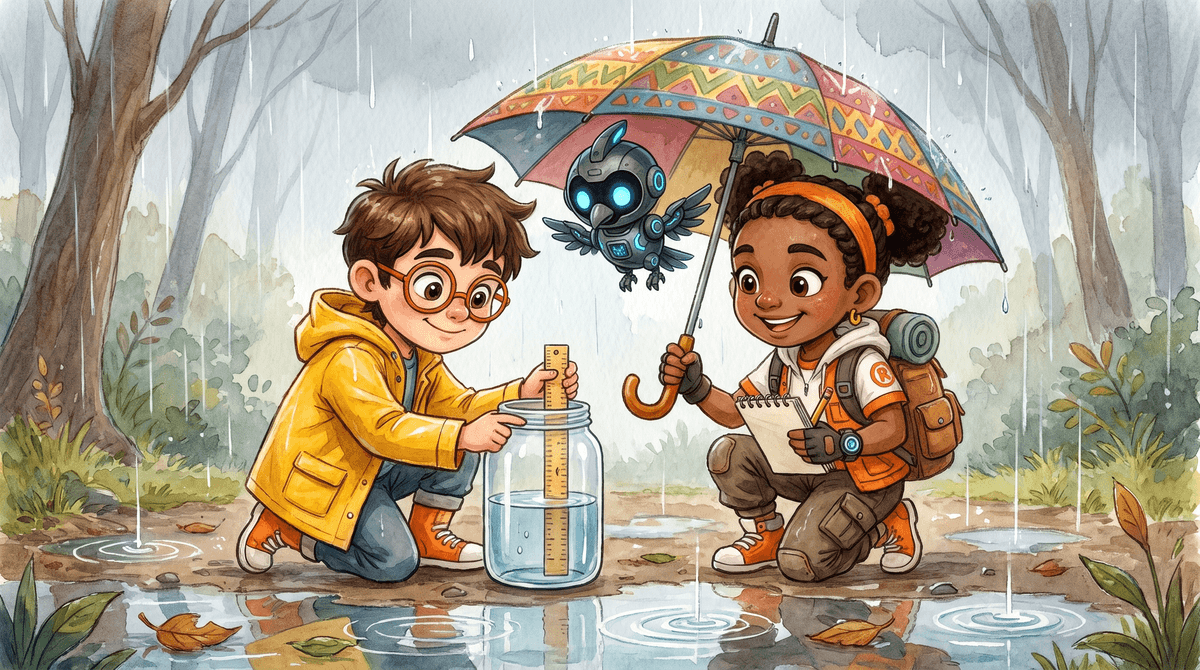
Rain drums on the roof of the lab all morning. Rocket races up to Station Rooftop the moment it stops.
"The jar is nearly full!" he shouts down the stairs. "That has to be a record."
Raven follows with the weather log and holds the jar up to the light. "What do you notice about the water?"
Rocket looks closer. Tiny pieces of ice are still bobbing near the top.
"So it was not only rain," he says slowly. "Something frozen fell too."
Nova drifts over the jar and scans it with a soft blue beam. "Clouds can release water in more than one form," she says. "Your log should say which ones."
Raven uncaps her pen. "Then this week we learn them all."
Precipitation
Precipitation is water released from clouds. It can fall as rain, freezing rain, sleet, snow or hail.
All five kinds start the same way: as cloud droplets or ice crystals that grow heavy enough to fall.
What reaches the ground depends on the air the drops fall through. Cold air near the ground changes rain into ice.
This week you will learn how each kind forms and measure rain with your own gauge. Then you will compare your numbers with a real report.
| Kind | What it is |
|---|---|
| Rain | Liquid drops large enough to fall |
| Snow | Branched ice crystals, mostly six-pointed stars |
| Sleet | Rain that turns into ice pellets before reaching the ground |
| Freezing rain | Rain that freezes when it hits the ground |
| Hail | Balls or lumps of ice that grow inside a thunderstorm |
- Read the question.
- Tap your answer.
From droplet to drop
A cloud droplet is far too small to fall on its own. It needs to grow first.
Tiny water droplets condense on even tinier particles of dust, salt or smoke.
Millions of cloud droplets are needed to make a single raindrop.
A drop falls out of the cloud when it falls faster than the rising air inside the cloud can hold it up.
| Statement | True or false? |
|---|---|
| Precipitation can be liquid or frozen. | ? |
| One cloud droplet is big enough to fall as a raindrop. | ? |
| Cloud droplets condense on tiny particles such as dust or salt. | ? |
| Snow crystals are mostly six-pointed stars. | ? |
Write it in your weather log with the time. If nothing is falling, write "none" and the cloud cover instead.
Readings are always taken after the rain ends, never during a storm.
Good start. Tomorrow you follow a drop on its way down and see how the air decides what it becomes.