Monday
Monday: The Invisible Water
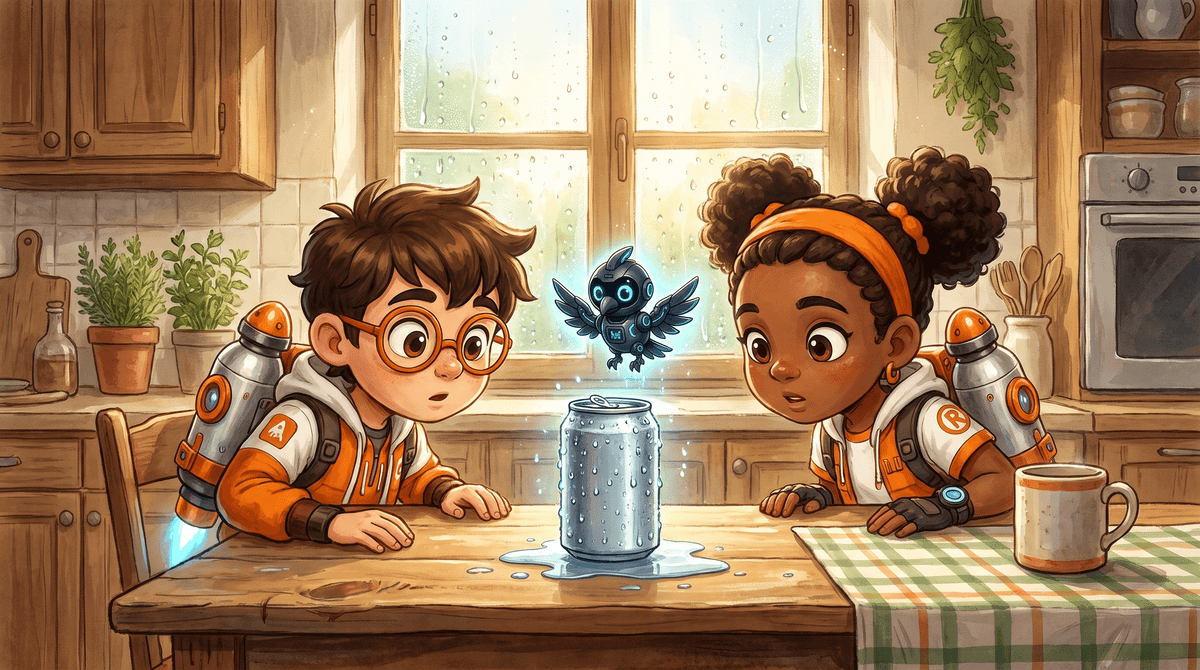
Rocket sets a cold can from the refrigerator on the Station Rooftop railing and starts the morning log. Ten minutes later the can is dripping.
"It is leaking!" he says, turning it over. Nothing is wrong with it.
Raven runs a finger down the wet side. "What do you notice? The drops are only on the outside, and the can is sealed."
"Then where did the water come from?" Rocket asks.
Nova hovers close and dims her light so the drops glint. "Think about what touched the can," she says. "Only the air did."
Rocket stares at the empty space around the can. "You mean the air is full of water we cannot see?"
"Not full," Raven says, writing it down. "But there is always some. And the cold can pulled it out."
Water in three states
Water exists in three states: solid ice, liquid water and a gas called water vapor. All three are in our atmosphere all the time.
Water vapor is invisible. Even on a clear blue day, water is in the air as vapor and as droplets too small to see.
The National Weather Service puts it simply: water is always present in Earth's atmosphere in some form.
Evaporation and condensation
Evaporation is the change of state from liquid to gas. It takes energy, and that energy can come from the Sun, the air, the ground or even your body.
That is why sweat cools you. Your body heat evaporates the water on your skin, and the heat leaves with it.
Condensation is the opposite: water vapor changes back into liquid. In the sky, condensation appears as clouds or dew.
It is also what puts water on the outside of a cold can or bottle. Air touching the cold surface cools, and its vapor condenses.
| Change | From | To | Where you see it |
|---|---|---|---|
| Evaporation | Liquid water | Water vapor | A puddle drying, sweat cooling your skin |
| Condensation | Water vapor | Liquid water | Drops on a cold can, dew on grass, clouds |
- Read the question.
- Tap your answer.
| Statement | True or false? |
|---|---|
| Water vapor is a gas. | ? |
| Evaporation needs energy. | ? |
| Condensation turns liquid water into a gas. | ? |
| There is no water in the air on a clear day. | ? |
| Dew is condensation. | ? |
Which change happened first, condensation or evaporation? Which happened second?
Water cycle facts come from the National Weather Service JetStream school and the U.S. Geological Survey Water Science School.
Good start. Tomorrow you will follow a single drop of water all the way around the water cycle.