Monday
Monday: Does Air Weigh Anything?
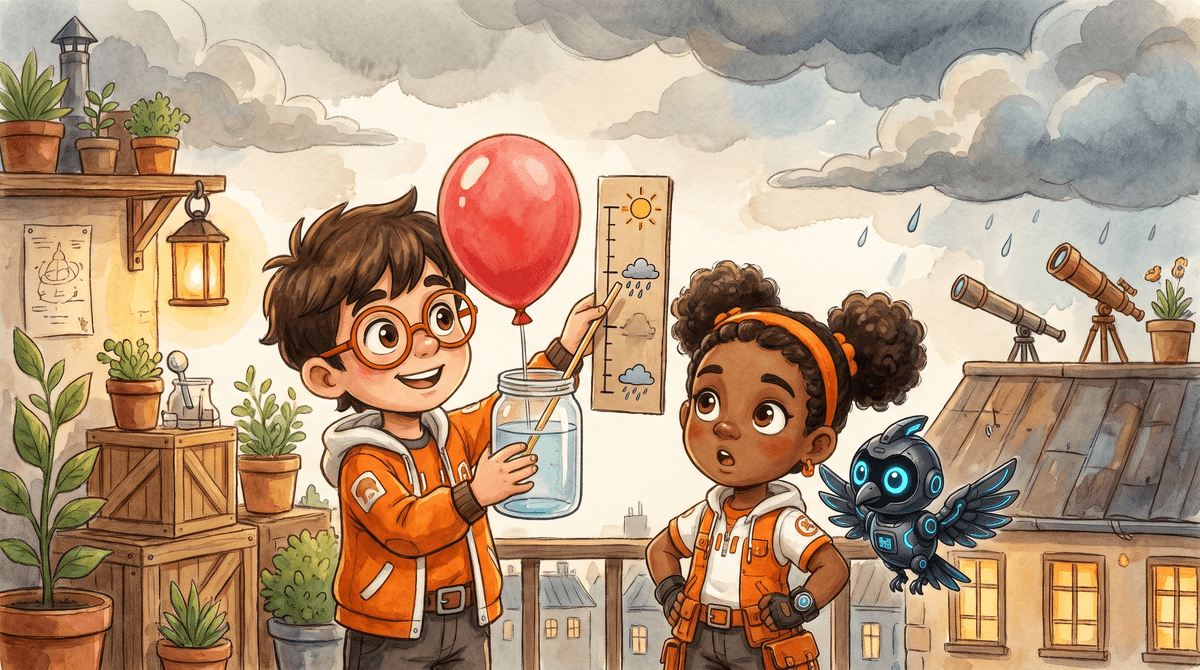
Rocket holds up two balloons, blown up to the same size and taped to the ends of a meter stick.
A string at the middle holds the stick level. "Perfectly balanced," he says. "Now watch."
Nova hovers close. "Before you do anything, predict. If one end gets heavier, which way will it move?"
"Down," Raven says. "But air does not weigh anything. Does it?"
Rocket carefully unties one balloon and lets the air hiss out. The stick tips. The full balloon sinks.
Raven stares. "What do you notice? The one with air in it is heavier."
"Now imagine a balloon as tall as the whole atmosphere," Nova says. "That weight is pressing on you right now."
Air is made of molecules
Air is all around us, and it is made of atoms and molecules. They are tiny, but there are a great many of them.
The National Weather Service explains that these molecules are constantly moving in random directions.
When they strike a surface, they exert a force on it. We observe that force as pressure.
Despite their small size, the huge number of molecules exerts a weight on us. We call that weight air pressure.
Our bodies are adapted to live under this weight, so we do not notice it.
The weight of a column of air
Scientists at the University Corporation for Atmospheric Research describe air pressure as the weight of all the air above us.
Above every square inch of the Earth's surface is 14.7 pounds of air. So air presses with 14.7 pounds per square inch at the surface.
When we measure air pressure with a barometer, we are measuring the weight of the column of air directly over us.
A barometer is simply an instrument that measures atmospheric pressure. The word comes from the Greek "baros", meaning weight.
- Read the question.
- Tap your answer.
| Statement | True or false? |
|---|---|
| Air is made of molecules that are constantly moving. | ? |
| Air weighs nothing at all. | ? |
| We notice air pressure all the time because it is so heavy. | ? |
| A barometer measures the weight of the column of air above it. | ? |
Predict first. Then untie one balloon and let the air out slowly. Which way does the stick tip?
Keep balloons and balloon pieces away from younger children. Nothing goes in the mouth.
A weighty idea, well handled. Tomorrow you climb a mountain in numbers and learn the units of pressure.