Friday
Friday: Everyday Given-Thats
"My cousin says most of the runners who stretched chose one lap," Comet says. "So stretching makes people pick one lap?"
"Careful," Wren says, spreading the sign-up cards. "That is P(one lap given stretched). You want P(stretched given one lap)."
"Different totals," Comet says. "One looks only at the stretchers. The other looks only at the one-lap runners."
Nova projects two shaded tables, a column lit in one, a row lit in the other. "Would you like a hint? Say each out loud."
"Of the stretchers, how many chose one lap. Of the one-lap runners, how many stretched," Comet says slowly.
"2/3 and 3/5," Wren says. "Everyday talk mixes them up all the time."
"Then our Race Day board needs clear labels," Comet says. "Every fraction says what it is given."
The sign-up cards
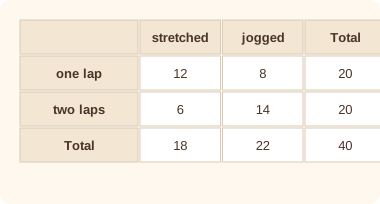
The crew sorted 40 sign-up cards by course and warm-up. Every count is the crew's own made-up tally.
| stretched | jogged | Total | |
|---|---|---|---|
| one lap | 12 | 8 | 20 |
| two laps | 6 | 14 | 20 |
| Total | 18 | 22 | 40 |
Saying it in everyday words
"Given that" means "among only those". P(stretched given one lap) is "among the one-lap runners, the fraction who stretched".
Swapping the two events swaps the group. "Among the stretchers, the fraction who chose one lap" is a different question.
Independence in everyday words: "knowing the lane half tells you nothing about even". Linked: "one-lap runners stretched more often than runners in general".
| Everyday sentence | Probability it means |
|---|---|
| Among the one-lap runners, three in five stretched. | P(stretched given one lap) = 3/5 |
| Among the stretchers, two in three chose one lap. | P(one lap given stretched) = 2/3 |
| Among the two-lap runners, three in ten stretched. | P(stretched given two laps) = 3/10 |
| Low or high, an even token came up just as often. | P(even given low) = P(even): independent |
Review: the week in five lines
- P(A) = outcomes in A ÷ all outcomes.
- P(not A) = 1 - P(A).
- P(A or B) = P(A) + P(B) - P(A and B).
- P(A given B) = outcomes in both ÷ outcomes in B = P(A and B) ÷ P(B).
- Independent: P(A given B) = P(A), or P(A and B) = P(A) × P(B).
- Read the question.
- Tap your answer.
- Read the question.
- Tap your answer.
Given that a runner chose one lap, what is the probability the runner stretched?Given that a runner stretched, what is the probability the runner chose one lap?What is the probability a random runner chose two laps or jogged (or both)?What is the probability a random runner did not stretch?| Statement | True or false? |
|---|---|
| "Among the stretchers" means the stretched column is the total. | ? |
| P(A given B) and P(B given A) always share the same top number. | ? |
| 12 ÷ 18 = 2/3 | ? |
| Most stretchers choosing one lap proves that stretching makes people choose one lap. | ? |
Write one everyday sentence of your own and translate it into a probability.
A clear-headed week. Tomorrow is Track Day: a family draw from a bag of six.