Track Day
Track Day: Is the Family Coin Fair?
Saturday the crew brings the coin home. The kitchen table becomes the pacing trial.
"Ten flips each," Comet tells the family. "Count your heads. The model expects 5, give or take 1.6."
"Anything from 2 to 8 is ordinary," Wren adds. "Zero, one, nine or ten would surprise us."
The counts come in: 6, 4, 5, 7. Nobody lands outside the band.
"So the coin is behaving," Comet says. "What do you notice about how different the counts are?"
"Four people, four counts, none exactly 5," Wren says. "Chance spreads them out. The band expects that."
Nova hovers over the table. "Would you like a hint? Try three heads in a row before you decide anything is odd."
Someone flips three heads in a row and gasps. "One in eight," Comet says, grinning. "Ordinary."
- A probability model says how chance should behave. Each try is independent.
- P(exactly k) counts the orders with C(n, k), then multiplies p for each success and 1 - p for each failure.
- The distribution lists every count with its probability, adding to 1. Its expected value is n × p.
- Ordinary: within two spreads √(n p (1 - p)) of the expected count. Surprising: beyond that.
- A surprising result is a reason to doubt the model and look for a cause, not proof of a new rate.
Mark each count on a number line from 0 to 10, and shade the ordinary band 1.8 to 8.2.
Take turns saying whether each count is ordinary or surprising, and why.
Then try a run of three or four heads in a row. Work out its probability together before anyone calls the coin odd.
If a count does land outside the band, treat it as a reason to flip again, not a verdict.
- Read the question.
- Tap your answer.
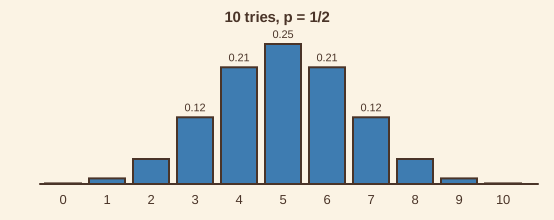 The fair-coin model expects 5 heads in 10 flips. A family member got 7. Is that consistent with the model?
Track Day done. Next week the crew turns a sample into an estimate, and learns how far to trust it: the margin of error.