Monday
Monday: Four Piles on a Grid of Tape
A stack of 48 sign-up cards sits on the table by the community center door. Comet lays down two strips of tape.
"Two questions per card," she says. "Morning slot or evening slot. Finished the practice loop or stopped early."
Wren sorts. Morning and finished, top left. Morning and stopped, top right. Evening below. Four piles grow on the grid.
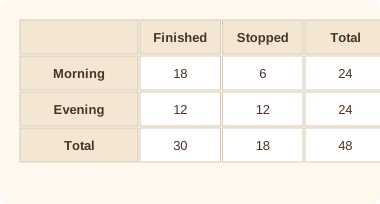
"18, 6, 12, 12," Comet counts. "What do you notice?"
"24 morning cards and 24 evening cards," Wren says. "Same size groups. But the piles inside them are not the same."
Nova projects a grid with totals along the edges. "Would you like a hint? Write the totals before you compare anything."
"A two-way table," Wren says. "Every card lands in exactly one cell."
"What can we make?" Comet asks. "A table that shows whether the morning runners finished more often."

The crew's two-way table
Every count this week is the crew's own made-up tally from Nova's Run Log. Each sign-up card is sorted by two questions at once.
| Finished | Stopped | Total | |
|---|---|---|---|
| Morning | 18 | 6 | 24 |
| Evening | 12 | 12 | 24 |
| Total | 30 | 18 | 48 |
Reading the table
The four inner cells are joint counts. Each one answers both questions at once: morning and finished, evening and stopped, and so on.
The row and column totals are marginal counts. They answer one question only: how many morning cards, how many finished cards.
The grand total, 48, is every card. Check it two ways: 24 + 24 and 30 + 18 both give 48.
A solved problem to study
Here is how Wren builds the table from the four piles and checks it.
- Count each pile: 18 morning and finished, 6 morning and stopped, 12 evening and finished, 12 evening and stopped.
- Add across each row: morning 18 + 6 = 24, evening 12 + 12 = 24.
- Add down each column: finished 18 + 12 = 30, stopped 6 + 12 = 18.
- Add the row totals and the column totals separately. Both give 48, so the table checks.
- Read the question.
- Tap your answer.
How many sign-up cards are both morning and finished?- Read the question.
- Tap your answer.
| Statement | True or false? |
|---|---|
| Every sign-up card lands in exactly one inner cell of the table. | ? |
| 18 + 6 + 12 + 12 = 48 | ? |
| A row total is a joint count. | ? |
| 30 + 18 = 24 + 24 | ? |
The cell with both colors is the morning-and-finished count.
A table that checks. Tomorrow you turn every count into a percent, three different ways.