Monday
Monday: Chance From 0 to 1
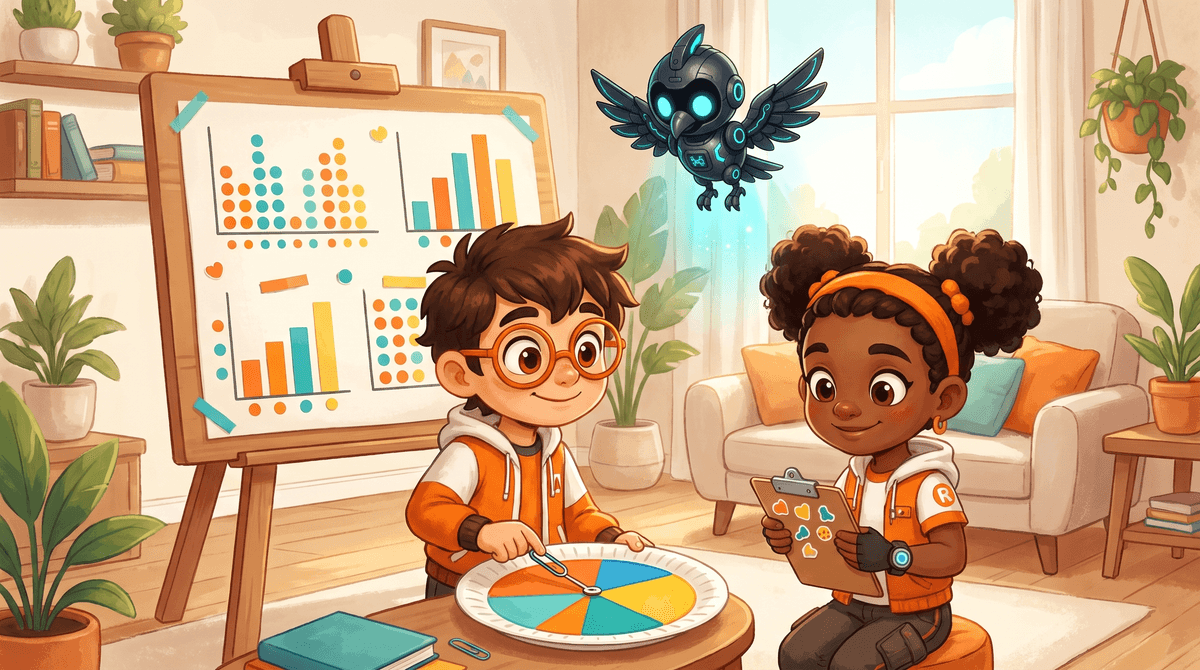
Rocket spins a paper plate on the Numbers Desk. "Field Day spinner game! Land on blue and you win a sticker."
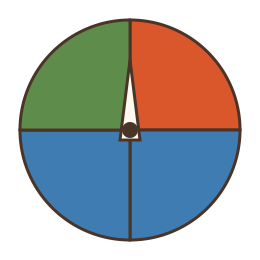
Raven studies the plate. "Four equal sectors. Two blue, one red, one green. What do you notice?"
"Blue is the biggest," Rocket says. "So blue wins most of the time. Almost always, probably."
Nova hovers over the plate. "How much of the plate is blue?"
Rocket counts. "Two sectors out of four. Half."
"So out of every two spins, about how many land on blue?" Nova asks.
"About one," Rocket says slowly. "Not almost always. Half the time."
"Half is 1/2," Raven says. "Chance has a number. Let us put every event on the scale from 0 to 1."
The probability scale
The probability of an event is a number from 0 to 1. It says how likely the event is to happen.
A probability of 0 means the event cannot happen. A probability of 1 means it is certain to happen.
A probability of 1/2 means the event is as likely to happen as not. Numbers near 0 are unlikely. Numbers near 1 are likely.
You can write a probability as a fraction, a decimal or a percent. 1/2, 0.5 and 50% all name the same chance.
| Probability | Word for it | Example on spinner A |
|---|---|---|
| 0 | impossible | landing on gold (there is no gold) |
| between 0 and 1/2 | unlikely | landing on red (1 of 4 sectors) |
| 1/2 | an even chance | landing on blue (2 of 4 sectors) |
| between 1/2 and 1 | likely | landing on blue or red (3 of 4 sectors) |
| 1 | certain | landing on red, blue or green |
Equally likely outcomes
Spinner A has four equal sectors. Each spin is equally likely to stop on any one of them. Each sector is one outcome.
With equally likely outcomes, the probability of an event is the number of outcomes that fit divided by all the outcomes.
Blue fills 2 of the 4 sectors. The probability of blue is 2/4 = 1/2.
Red fills 1 sector. The probability of red is 1/4. Green is the same, 1/4.
Add them up: 1/4 + 1/2 + 1/4 = 1. Every spin lands somewhere, so the probabilities of all the outcomes add to 1.
- Read the question.
- Tap your answer.
What is the probability of landing on blue?What is the probability of landing on red?What is the probability of landing on red or green?What is the probability of landing on gold on spinner A?- Read the question.
- Tap your answer.
| Statement | True or false? |
|---|---|
| A probability of 0 means the event is certain. | ? |
| A probability of 1/2 means an even chance. | ? |
| The probabilities of all the outcomes of a spinner add to 1. | ? |
| On spinner A, blue is more likely than red. | ? |
| A probability can be bigger than 1. | ? |
Place each one on a line from 0 to 1 in your Numbers Notebook.
Chance now has a number. Tomorrow you use that number to predict what 40 spins will do.