Monday
Monday: Is It Proportional?
Rocket carries two seedling pots to the Numbers Desk, each with a paper ruler taped to the side. "Week four. Measuring day."
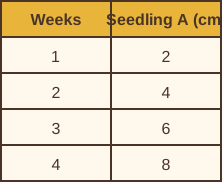
Raven opens the seedling log. "Seedling A: 2, 4, 6, 8 centimeters at weeks 1 to 4. Seedling B: 3, 4, 5, 6."
"Both grow the same amount each week," Rocket says. "So both are proportional. Done."
"What do you notice when you divide each height by its week?" Raven asks.
Rocket divides. "A gives 2, 2, 2, 2. B gives 3, then 2, then... not 2."
Nova hovers over the log, her light resting on the first row for B. "Where did B start?" she asks.
"At 2 centimeters, before week 1," Rocket says. "A started at zero. That is the difference."
"Proportional means a straight line through zero," Raven says. "This week we test for it."

The test for proportional
Two quantities are proportional when they grow together in a steady ratio. Double one, and the other doubles too.
The test: divide each y by its x. If every quotient is the same number, the relationship is proportional.
That shared number is the constant of proportionality, written k. It is also the unit rate: the y when x is 1.
Seedling A: 2 ÷ 1 = 2, 4 ÷ 2 = 2, 6 ÷ 3 = 2, 8 ÷ 4 = 2. Every quotient is 2. Proportional, with k = 2.
Seedling B: 3 ÷ 1 = 3, 4 ÷ 2 = 2, 5 ÷ 3 = 5/3, 6 ÷ 4 = 1.5. The quotients differ. Not proportional.
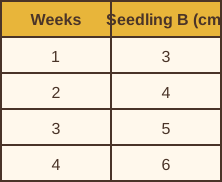
Seedling B grows 1 cm every week, a steady amount. But it started at 2 cm, so height is not proportional to weeks.
Steady growth is not enough. Proportional also means zero of one goes with zero of the other.
In a proportional table, every row is an equivalent ratio. 2:1, 4:2, 6:3 and 8:4 all equal 2.
- Write each pair as y ÷ x.
- Work out every quotient.
- If they are all the same number, it is proportional and that number is k.
- If any quotient is different, it is not proportional.
- Read the question.
- Tap your answer.
- Read the question.
- Tap your answer.
- Read the question.
- Tap your answer.
| Statement | True or false? |
|---|---|
| Proportional means every y ÷ x is the same number. | ? |
| Any table where y grows by the same amount each row is proportional. | ? |
| 8 ÷ 4 = 2 | ? |
| 6 ÷ 4 = 1.5 | ? |
| Seedling B is proportional because it grows 1 cm every week. | ? |
Measure each mark from the bottom in millimeters. Divide each height by its spoonfuls. Is it proportional?
Pour over a tray or the sink, and wipe any spill right away.
Sharp testing. Tomorrow you graph both seedlings and see the straight line through zero.