Monday
Monday: Hops on the Number Line
Rocket bursts into the kitchen holding the porch thermometer. "It read -3 at breakfast. Since then it rose 5 degrees."
"So now it reads 8," he says, already writing the 8 in the Numbers Desk notebook.
Raven taps the paper number line taped to the table. "What do you notice about where -3 sits?"
Rocket looks. "It is left of zero. If I hop 5 to the right, I cross zero on the way."
Nova glides over the table, her light tracing each hop. "Count the hops, not the numbers," she says.
Rocket counts out loud. "-2, -1, 0, 1, 2. It reads 2 now, not 8."
"Field Day scores above and below par work the same way," Raven says. "This week, we hop."

Adding is hopping
Last week you placed signed numbers on a number line. This week the numbers move.
To add, start at the first number. Then hop the size of the second number.
A positive number hops to the right. A negative number hops to the left.
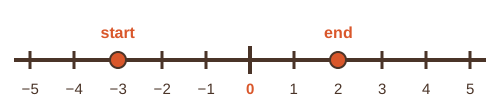
So -3 + 5 starts at -3 and hops 5 to the right. The hops land on -2, -1, 0, 1 and 2.
The sum is 2. Rocket's 8 came from ignoring the sign on the -3.
Now try 4 + (-6). Start at 4. The second number is negative, so hop 6 to the left.
The hops land on 3, 2, 1, 0, -1 and -2. The sum is -2.
When both numbers are negative, every hop goes left. -2 + (-5) starts at -2 and ends at -7.
Opposites make zero
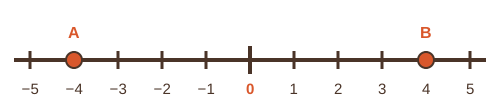
A number and its opposite sit the same distance from 0 on opposite sides. 4 and -4 are opposites.
Start at 4 and hop 4 to the left. You land on 0. So 4 + (-4) = 0.
Two numbers that add to 0 are called a zero pair, or additive inverses.
Zero pairs show up everywhere. A score of 3 above par and 3 below par makes par exactly.
A thermometer that rises 6 degrees and then falls 6 degrees is back where it started.
- Find the first number on the number line. Put your finger there.
- Read the sign of the second number. Positive means hop right. Negative means hop left.
- Hop that many whole steps, counting each one.
- The number you land on is the sum.
- Read the question.
- Tap your answer.
- Read the question.
- Tap your answer.
| Number sentence | True or false? |
|---|---|
| -3 + 5 = 2 | ? |
| 4 + (-6) = 2 | ? |
| -2 + (-5) = -7 | ? |
| -6 + 6 = 0 | ? |
Show -3 + 5: three negative counters and five positive counters.
Pair each negative with a positive. Each pair is a zero pair worth 0. Set the pairs aside.
Count what is left. Two positive counters remain, so the sum is 2.
Strong start. You hopped your way to signed sums. Tomorrow you learn why subtracting is just adding the opposite.