Tuesday
Tuesday: Unit Rates and Double Number Lines
Raven draws two long lines across a sheet at the Numbers Desk, one above the other. "Meters on top. Seconds underneath."
Rocket marks 5 over 1, then 10 over 2. "It is a ratio table turned sideways!"
"What do you notice about the jumps?" Raven asks. "Five more meters every second," Rocket says. "Always five."
Nova hovers at the end of the line. "So where would 12 seconds land? Do not count. Multiply."
"Five times twelve. Sixty meters," Rocket says. "In 12 seconds I would be across the whole yard."
Raven adds a third line underneath, labeled Centimeters. "Now the fun part. Each meter is 100 of these."
The method
- Write the rate as it was measured: 40 meters in 8 seconds.
- Divide the first amount by the second: 40 ÷ 8 = 5.
- Say the unit rate with per: 5 meters per second.
- To predict, multiply the unit rate by any time: 5 × 12 = 60 meters in 12 seconds.
| Rate as measured | Divide | Unit rate |
|---|---|---|
| 40 meters in 8 seconds | 40 ÷ 8 | 5 meters per second |
| 30 meters in 5 seconds | 30 ÷ 5 | 6 meters per second |
| 24 pages in 6 minutes | 24 ÷ 6 | 4 pages per minute |
| 12 centimeters in 4 weeks | 12 ÷ 4 | 3 centimeters per week |
Double number lines
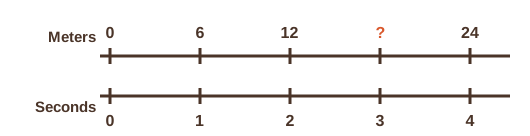
A double number line shows a rate at many sizes. The top line counts one unit, the bottom line the other.
Every pair that lines up is an equivalent rate. Reading across to 1 on the bottom gives the unit rate.
Changing units with a ratio
Units change with ratios too. There are 60 seconds for every 1 minute, and 100 centimeters for every 1 meter.
To change 3 minutes to seconds, multiply: 3 × 60 = 180 seconds. To change 250 centimeters to meters, divide by 100.
- Read the question.
- Tap your answer.
- Read the question.
- Tap your answer.
The double number line shows 6 meters every second. What number goes in the blank over 3 seconds?- Read the question.
- Tap your answer.
| Number sentence | True or false? |
|---|---|
| 40 ÷ 8 = 5 | ? |
| 3 × 60 = 200 | ? |
| 30 ÷ 5 = 7 | ? |
| 2 × 100 = 200 | ? |
Good method. Tomorrow the Numbers Lab goes outside to time real walks and runs.