Monday
Monday: What a Rate Is
Rocket bursts through the back door, out of breath. "Forty meters in 8 seconds. I am the fastest on the street."
Raven looks up from the Numbers Desk. "I ran 30 meters in 5 seconds this morning."
"Forty is more than thirty," Rocket says. "So I win."
"What do you notice about the seconds?" Raven asks. Rocket pauses. "Yours are fewer. But you also ran less."
Nova hovers over the notebook, her light tracing the two lines. "Two numbers each. Hard to compare. What if each run lasted exactly 1 second?"
Rocket grabs a pencil. "Forty divided by eight is 5. Thirty divided by five is 6." He stares.
"Six is more than five," Raven says, and smiles.

A ratio with two different units
Last week a ratio compared two amounts of the same kind, like spoons of blue to spoons of yellow.
A rate is a ratio of two quantities with different units. Rocket's run is 40 meters to 8 seconds.
A unit rate tells the amount for exactly 1 of the second unit. Divide: 40 ÷ 8 = 5 meters per second.
Per means for each one. Speed is a rate that compares distance to time, so 5 meters per second is a speed.
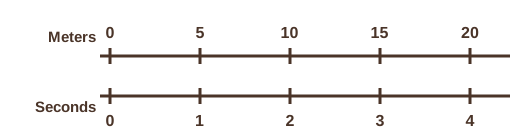
Worked example: compare two runs
Raven ran 30 meters in 5 seconds. Her unit rate is 30 ÷ 5 = 6 meters per second.
Rocket ran 40 meters in 8 seconds. His unit rate is 40 ÷ 8 = 5 meters per second.
Unit rates make the comparison fair. In 1 second, Raven covers 1 meter more than Rocket.
The word per is the signal. Meters per second, pages per minute and steps per minute are all unit rates.
A unit rate also predicts. At 6 meters per second, Raven covers 6 × 10 = 60 meters in 10 seconds.
- Read the question.
- Tap your answer.
- Read the question.
- Tap your answer.
| Number sentence | True or false? |
|---|---|
| 40 ÷ 8 = 5 | ? |
| 30 ÷ 5 = 6 | ? |
| 24 ÷ 6 = 3 | ? |
| 300 ÷ 3 = 100 | ? |
Your count is a unit rate: steps per minute. Write it in your Numbers Notebook.
Predict your steps for 3 minutes. Then test it if you have time.
Stop if you feel out of breath. This is counting, not a contest.
Fair comparison. Tomorrow you learn the method for unit rates, double number lines and changing units.