Monday
Monday: Two Angles and a Tape
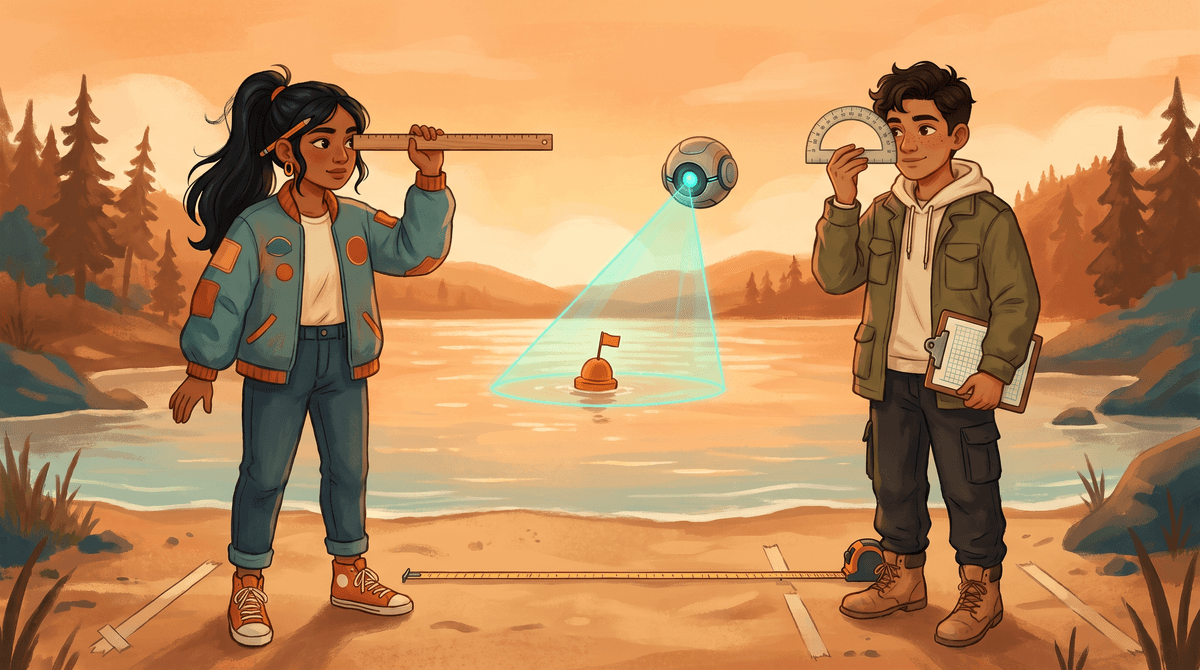
Comet stakes one end of the tape at the shore and walks it out along the beach. "120 meters. That is our baseline."
Wren stands at the first stake with a protractor and sights the red buoy. "Forty degrees from the tape."
He walks to the far stake and sights again. "65 degrees. What do you notice? We never got our feet wet."
Nova projects a triangle over the water: two stakes and the buoy. "The third angle is yours to find."
"180 minus 40 minus 65," Comet says. "75 degrees at the buoy. But how far away is it? No right angle anywhere."
"Would you like a hint?" Nova asks. "Drop a line from the buoy straight down to the tape. Now you have two right triangles."
"Two right triangles sharing one height," Wren says. "Let us see where that leads."
Naming an oblique triangle
Call the shore stakes A and B and the buoy C. Each side takes the lowercase letter of the angle across from it.
So side c is the baseline AB. Side b runs from A to the buoy, and side a from B to the buoy.
A triangle with no right angle is called oblique. The sine, cosine and tangent ratios from Geometry need a right angle, so we build one.
The Law of Sines
Drop a height h from C to the baseline. In the right triangle at A, h = b sin A. In the one at B, h = a sin B.
The two expressions are the same height, so b sin A = a sin B. Divide both sides by sin A sin B: a/sin A = b/sin B.
Drop a height from a different vertex and the same argument brings in c/sin C. This is the Law of Sines.
In words: each side divided by the sine of the angle across from it gives the same number, all around the triangle.
A solved problem to study
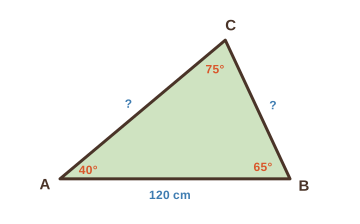
- Known: c = 120 m, A = 40°, B = 65°. Find C, then the two sides to the buoy.
- C = 180° - 40° - 65° = 75°. Now every angle is known and one side.
- Law of Sines: b/sin B = c/sin C, so b = c sin B / sin C.
- Put in the numbers: b = 120 × 0.906 / 0.966 ≈ 112.6 m.
- Again: a = c sin A / sin C = 120 × 0.643 / 0.966 ≈ 79.9 m.
- Check: the biggest angle, C, sits across from the biggest side, c = 120. The smallest angle, A, faces the smallest side, a.
- Answer: the buoy is about 112.6 meters from stake A and 79.9 meters from stake B.
Notice the pattern. Match each side with its own angle, write two equal fractions, and solve for the one unknown.
Every length here is the crew's own tape reading from Nova's log, not a fact about any real lake.
- Read the question.
- Tap your answer.
The baseline is 120 m, A = 40° and B = 65°. How far is the buoy from stake A, to 1 place?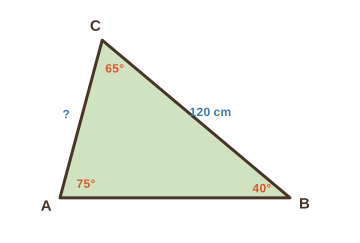 In the buoy triangle, the 120 m baseline faces the 75° angle at the buoy. Find the side facing the 40° angle, to 1 place.
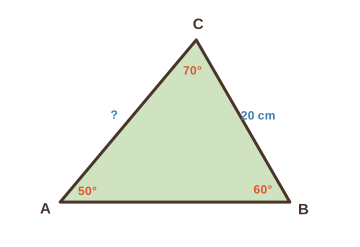 In a triangle, angle A = 50°, angle B = 60° and side a (opposite A) = 20 m. Find side b to 1 place.
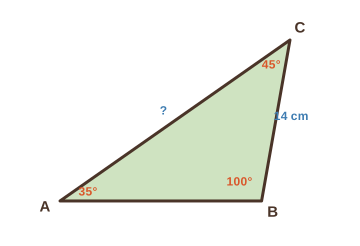 In a triangle, angle A = 35°, angle B = 100° and side a (opposite A) = 14 m. Find side b to 1 place.
| Statement | True or false? |
|---|---|
| In the Law of Sines, each side is paired with the angle across from it. | ? |
| Side c is the side between angles A and B. | ? |
| The Law of Sines only works in right triangles. | ? |
| 180 - 40 - 65 = 75 | ? |
| The biggest side of a triangle faces the smallest angle. | ? |
Measure the angles with a protractor and the sides with a ruler. Compute a ÷ sin A and b ÷ sin B. Close?
Strong start. Tomorrow two sides and the angle between them call for a different law.