Monday
Monday: A Light and Its Reflection
Evening settles over the Boathouse, and the five dock lights flick on for the first time in years.
"Look at the water," Comet says. "Every light has a twin under it. What can we make of that?"
Wren spreads graph paper on the dock. "Nova, where is each light in the log?"
Nova projects a grid of dots over the water. "The gauge post is 0. Light A is 3 meters along the dock and 2 out."
"So A is the point (3, 2)," Wren says. "And its reflection is (3, -2). What do you notice?"
"Same across, flipped up and down," Comet says. "Like 3 + 2i and 3 - 2i from Algebra 2."
Nova dims to a hint. "Would you like a hint? Those are not just like complex numbers. They are complex numbers."

A complex number is a point
A complex number a + bi has a real part a and an imaginary part b. Plot it as the point (a, b).
The horizontal axis is the real axis. The vertical axis is the imaginary axis. Together they make the complex plane.
Light A at 3 + 2i sits 3 to the right and 2 up. Light C at -2 + 3i sits -2 across and 3 up.
A real number like 4 sits on the real axis. A pure imaginary number like 3i sits on the imaginary axis.
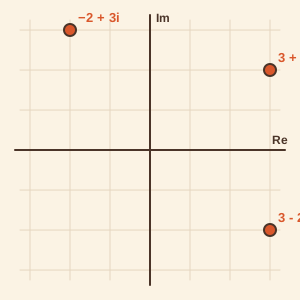
The conjugate is the reflection
The conjugate of a + bi is a - bi. Keep the real part, flip the sign of the imaginary part.
The conjugate of 3 + 2i is 3 - 2i. On the plane that is a reflection in the real axis, the light's twin in the water.
A real number is its own conjugate. Its imaginary part is 0, and flipping 0 changes nothing.
A solved problem to study
- Light A is at 3 + 2i and light B is at 1 + 4i, from Nova's log.
- Add them: (3 + 2i) + (1 + 4i) = 4 + 6i. Real parts add, imaginary parts add.
- Subtract: (1 + 4i) - (3 + 2i) = -2 + 2i. This is the move from A to B.
- Conjugate A: 3 - 2i. Only the sign of the imaginary part changes.
- Check on the grid: 4 + 6i sits where the two moves, one after the other, land.
Notice that every answer is also a point. Complex arithmetic always lands somewhere on the plane, and this week we watch where.
The dock lights in Nova's log
| Light | Complex number | Real part | Imaginary part | Conjugate |
|---|---|---|---|---|
| A | 3 + 2i | 3 | 2 | 3 - 2i |
| B | 1 + 4i | 1 | 4 | 1 - 4i |
| C | -2 + 3i | -2 | 3 | -2 - 3i |
| D | -4 - i | -4 | -1 | -4 + i |
| E | 2 - 3i | 2 | -3 | 2 + 3i |
- Read the question.
- Tap your answer.
| Statement | True or false? |
|---|---|
| The point for 3 + 2i is 3 across and 2 up. | ? |
| The conjugate of a + bi is -a + bi. | ? |
| A real number lies on the real axis of the complex plane. | ? |
| The conjugate of a complex number is its reflection in the imaginary axis. | ? |
| 3 + 1 = 4 | ? |
Plot each conjugate in a second color. Fold along the real axis and check that each pair meets.
Strong start. Tomorrow the conjugate earns its keep: it measures each light's distance from the post and divides one number by another.