Monday
Monday: The Bench Opens
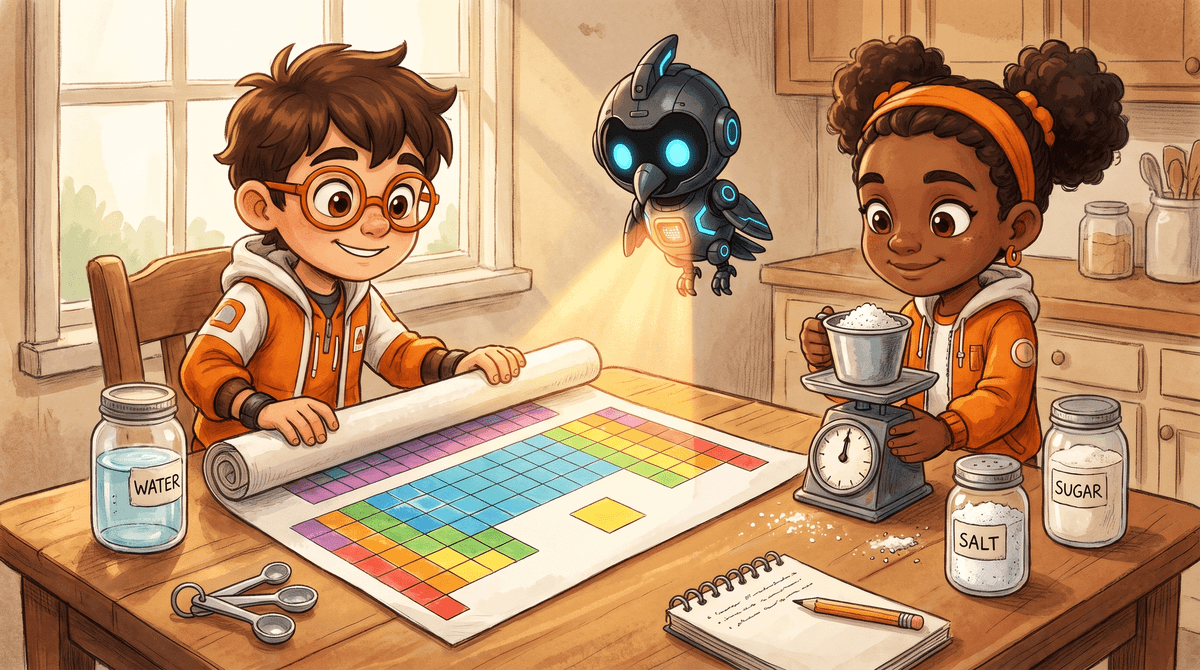
Rocket slides the fruit bowl to the far end of the kitchen table and wipes the wood clean. "This end is now the Bench," he announces.
He lines up clear cups, a measuring cup, a box of salt and a jar of baking soda. "A chemistry bench. Kitchen things only."
Raven sets a notebook beside the cups and writes Bench Log on the cover. "What do you notice about everything here?" she asks.
"It is all stuff," Rocket says. "Salt, water, cups, the table. Stuff you can hold."
Nova hovers over an empty cup, her light glowing soft blue. "Is this cup really empty?" she asks. "Think about what fills it."
Rocket peers in. "Air," he says slowly. "But air is not stuff. Is it?"
Raven taps her pencil on the log. "That is our first question," she says. "Let us find out."
What is matter?
Matter is all the "stuff" that exists in the universe. Everything you can see and touch is made of matter, including you.
In science, matter is defined as anything that has mass and volume. Volume means it takes up space.
The only things that are not matter are forms of energy, such as light and sound. A beam of light has no mass and takes up no space.
For most objects it is easy to show they have mass and take up space. A rock is heavy and fills your hand.
Is air matter?
Air and other gases are invisible. They have very small masses compared to equal amounts of solids and liquids, and they are easy to compress.
Hundreds of years ago, people found it hard to believe that air had mass and volume. Today we can measure it.
Measure the mass of a small balloon when it is deflated. Blow it up, tie it off, and measure its mass again. The filled balloon has more mass.
The air in a one quart jar has a mass of about 0.0002 pounds under room conditions. That is tiny, but it is not zero.
So air is matter. Rocket's "empty" cup is full of it.
- Read the question.
- Tap your answer.
Mass is not the same as weight
Mass is a measure of the amount of matter in an object. The basic unit for mass is the kilogram, and smaller masses are measured in grams.
To measure mass, you use a balance. A kitchen scale at home gives you a reading in grams too.
Weight is different. Weight measures the force of gravity acting on an object.
The force of gravity on an object depends on its mass, and also on the strength of gravity where it is.
All over Earth, gravity is about the same strength. So on Earth, a greater mass always means a greater weight.
With Earth's gravity, an object with a mass of 1 kilogram has a weight of 2.2 pounds.
| Statement | True or false? |
|---|---|
| Matter is anything that has mass and volume. | ? |
| Sound is a kind of matter. | ? |
| Air is matter. | ? |
| Mass measures the force of gravity on an object. | ? |
| The basic unit of mass is the kilogram. | ? |
Hold one in each hand and decide which has more mass. Then check with a kitchen scale if your family has one.
Write the three objects in your Bench Log from least mass to most mass.
- Tap a card.
- Then tap its spot.
Nothing is tasted or smelled up close, and nothing goes in the mouth. Hands are washed after every Bench Lab.
The facts this week come from NASA, the National Institute of Standards and Technology, the NIH PubChem periodic table and LibreTexts chemistry.
Great start, chemist. Tomorrow you will learn how to measure matter: mass on a balance and volume in a cup.