Wednesday
Wednesday: Two digits times two digits
At the third challenge stop, Bruce has planted a garden of sunflowers.
"There are 23 rows, and each row has 14 sunflowers," he says.
"This is my hardest challenge yet. Both numbers have two digits!"
Bennie nods slowly. "Then both numbers get split by place value."
"23 is 20 and 3. And 14 is 10 and 4."
"That makes four boxes instead of two."
Bruce smiles. "Four small jobs. I like that plan."
Learn it: tens times tens
20 × 10 = 200. Two tens times one ten is two hundreds.
30 × 40 = 1,200, because 3 × 4 = 12, and tens times tens make hundreds.
- Read the question.
- Tap your answer.
Learn it: four boxes
For 23 × 14, the side shows 20 and 3. The top shows 10 and 4.
| × | 10 | 4 |
|---|---|---|
| 20 | 200 | 80 |
| 3 | 30 | 12 |
Add the four partial products: 200 + 80 + 30 + 12 = 322.
So 23 × 14 = 322 sunflowers.
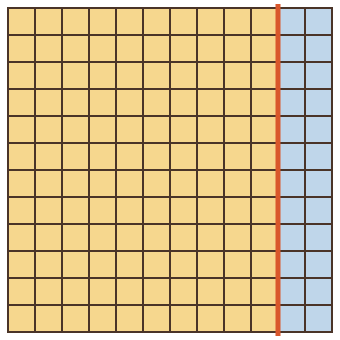
This grid shows 12 × 12. The split gives 12 × 10 + 12 × 2 = 120 + 24 = 144.
- Split 36 into 30 and 6.
- Split 18 into 10 and 8.
Add them: 300 + 240 + 60 + 48 = 648.
- Read the question.
- Tap your answer.
- Think about the four boxes.
- Tap the steps in order.
| Sentence | True or false? |
|---|---|
| 20 × 40 = 800 | ? |
| 11 × 11 = 121 | ? |
| 15 × 15 = 215 | ? |
| 23 × 14 has four partial products. | ? |
Outline a rectangle 12 squares long and 11 squares tall.
Draw a line after 10 squares each way.
Count each part and add. Do you get 132?
Four boxes, one product! Tomorrow Chris tells a story full of multiplying.