Monday
Monday: What a network is
A neighbor brings two tablets to the Fix-It Bay. "They sit side by side, but they cannot share a photo," she says. Rocket holds them close together. "Maybe they need to touch?"
Raven shakes her head and smiles. "What do you notice? Each tablet is a whole computer by itself. How could two computers talk?"
Nova circles once. "Would you like a hint? Computers talk when they are connected. The connection can be a cable, or it can be invisible."
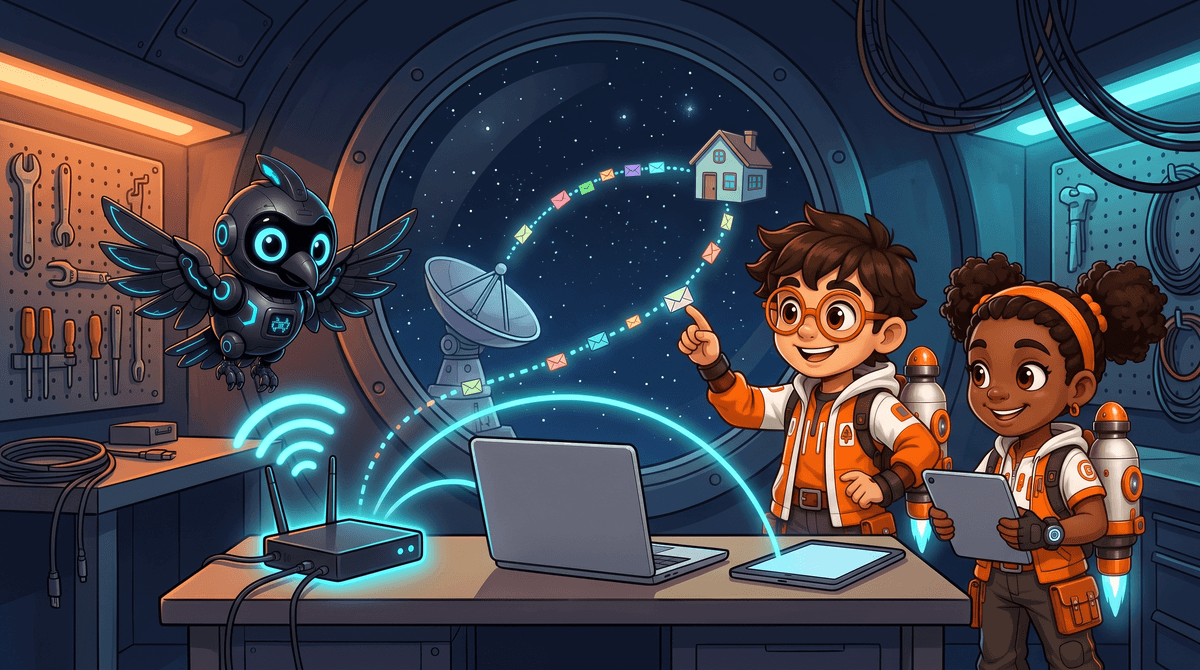
Connected computers
One computer is useful. Two connected computers are much more useful. They can share photos, messages and files.
A network is a group of devices connected so they can share information.
Your home may have a small network. A phone, a tablet, a laptop and a printer might all be on it.
A school has a bigger network. The internet is the biggest network of all. It connects networks all over the world.
| Network | Size | Example |
|---|---|---|
| Home network | A few devices | A tablet, a phone and a printer in one home |
| School network | Hundreds of devices | Every classroom computer in a building |
| The internet | Billions of devices | Networks all over the world, joined together |
- Read the question.
- Tap your answer.
Wires and radio
Devices join a network in two ways. Some use a cable. Some use radio waves.
A network cable carries signals as tiny pulses of electricity. Cables are steady and fast, but you have to plug them in.
Wi-Fi uses radio waves instead. The device has a small antenna inside. So does the router.
Radio waves pass through air and most walls. You cannot see them, hear them or feel them.
A grown-up handles any cable that plugs into a wall or a router. You may look, but not plug or unplug.
- Cable: steady, fast, must be plugged in by a grown-up.
- Wi-Fi: no cable, works across a room, uses radio waves.
- Both carry the same kind of information. Only the path is different.
- Read the question.
- Tap your answer.
| Statement | True or false? |
|---|---|
| Wi-Fi uses radio waves. | ? |
| You can see Wi-Fi signals in the air. | ? |
| A network cable carries signals as electricity. | ? |
| Two tablets next to each other are always a network. | ? |
Guess which use a cable and which use Wi-Fi.
Check your guess with a grown-up.
Leave the router where it is. A grown-up handles it.
Great start, Crew Technician! You know what a network is and what carries the signal. Tomorrow you meet the small box that runs the home network.