Tuesday
Tuesday: Cones and Spheres
Rocket rolls paper into a cone with the same radius and height as the can. "The roof! How much does it hold?"
"Less than the can," Raven says. "It narrows to a point. What do you notice about how much less?"
"Half?" Rocket guesses. Raven fills the cone with rice over a tray and pours it into the can. "Not full."
A second cone-ful. Still not full. A third, and the rice reaches the rim exactly.
"Three cones fill the can," Rocket says. "So a cone is one third of its cylinder!"
Nova hovers over the tray, her light on a rubber ball beside the can. "The ball has a rule too," she says.
Nova hums. "Four thirds, times π, times the radius three times. Write it, then test it on the ball."
A cone is one third of its cylinder
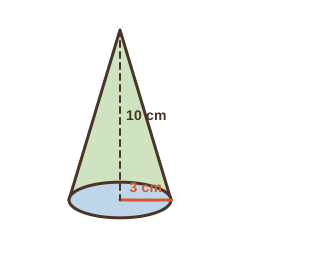
A cone with radius r and height h holds one third of the cylinder with the same r and h. V = ⅓ πr²h.
The crew's cone: ⅓ × 3.14 × 3 × 3 × 10 = 94.2 cubic centimeters. Three of those make 282.6, the can.
The sphere
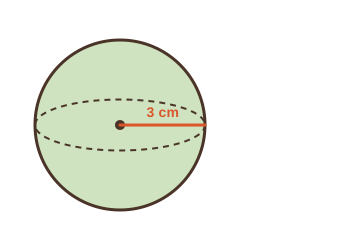
A sphere with radius r has volume V = 4/3 × π × r³. The radius is used three times: r × r × r.
A ball with radius 3 cm: 4/3 × 3.14 × 3 × 3 × 3 = 113.04 cubic centimeters.
| Solid | Formula | r = 3, h = 10 (cubic cm) |
|---|---|---|
| Cylinder | π × r² × h | 282.6 |
| Cone | ⅓ × π × r² × h | 94.2 |
| Sphere | 4/3 × π × r³ | 113.04 |
Same radius, and the can is the biggest of the three. The cone is exactly a third of the can.
- Read the question.
- Tap your answer.
The paper cone has radius 3 cm and height 10 cm. What is its volume in cubic centimeters? (Use 3.14 for π.)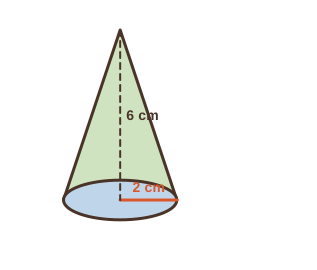 A cone has radius 2 cm and height 6 cm. What is its volume in cubic centimeters? (Use 3.14 for π.)
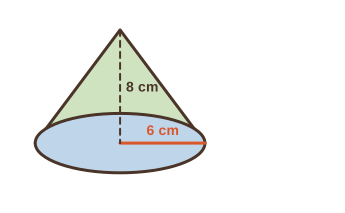 A cone has radius 6 cm and height 8 cm. What is its volume in cubic centimeters? (Use 3.14 for π.)
- Read the question.
- Tap your answer.
A ball has radius 3 cm. What is its volume in cubic centimeters? (Use 3.14 for π.)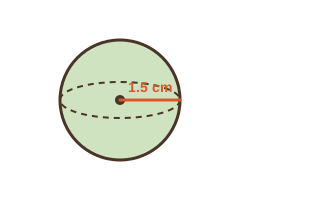 A ball has radius 1.5 cm. What is its volume in cubic centimeters? (Use 3.14 for π.)
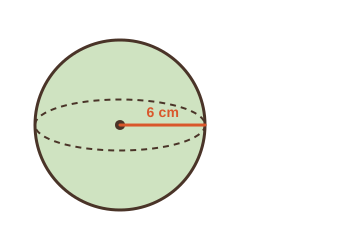 A ball has radius 6 cm. What is its volume in cubic centimeters? (Use 3.14 for π.)A ball with radius 3 cm sits inside a can of radius 3 cm. What is the ball's volume in cubic centimeters? (Use 3.14 for π.)
| Statement | True or false? |
|---|---|
| A cone holds one third of the cylinder with the same base and height. | ? |
| A sphere's formula uses the radius three times. | ? |
| Three cone-fuls of rice overflow the matching can. | ? |
| A cone with the same base and height holds half the cylinder. | ? |
- ?Multiply by the height to get the matching cylinder.
- ?Measure the radius and the height.
- ?Square the radius and multiply by 3.14. That is the base area.
- ?Take one third of that.
Measure its height from the point to the mouth. Work out its volume with 3.14.
Three solids, three formulas. Tomorrow is Build Lab: you pour the rice and count the cone-fuls yourself.