Monday
Monday: The Can Tank
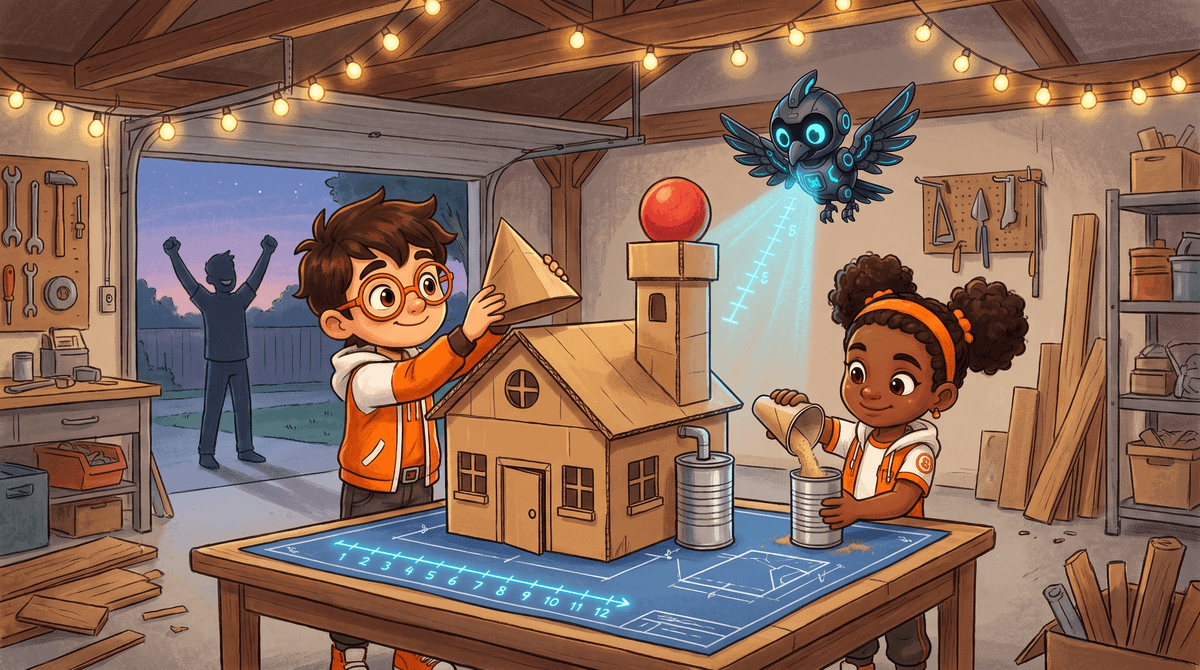
Rocket sets an empty can with a smooth rolled rim on the Blueprint Table. "The clubhouse rain tank. How much does it hold?"
"What do you notice about its shape?" Raven asks. "Round top, round bottom, straight sides. A cylinder."
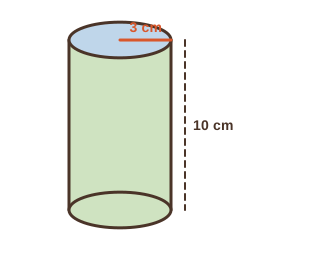
Raven measures twice. "Across the top is 6 centimeters, so the radius is 3. The height is 10."
"Last month we filled a box with cubes," Rocket says. "Base area times height. Does that work for a round base?"
Nova hovers above the can, her light drawing the circle on top. "Find the base area first," she says.
"Three point one four times 3 times 3," Rocket says. "28.26 square centimeters. Then times the height!"
Nova hums. "Ten layers of that base. Write the number, then check the units."
Volume of a cylinder
A cylinder is a stack of identical circles. Its volume is the base area times the height, just like a box.
The base is a circle with area πr². So the volume is V = πr²h. Use 3.14 for π.
The crew's can: radius 3 cm, height 10 cm. Base area 3.14 × 3 × 3 = 28.26. Volume 28.26 × 10 = 282.6 cubic centimeters.
Three steps every time
- Find the radius. If you measured across the top, halve it.
- Base area: 3.14 × r × r.
- Multiply by the height. The answer is in cubic units.
- Read the question.
- Tap your answer.
- Read the question.
- Tap your answer.
The crew's can has radius 3 cm and height 10 cm. What is its volume in cubic centimeters? (Use 3.14 for π.)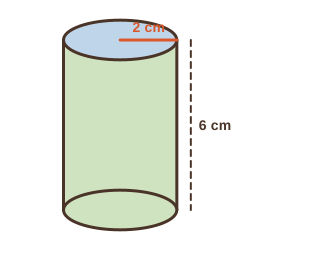 A cylinder has radius 2 cm and height 6 cm. What is its volume in cubic centimeters? (Use 3.14 for π.)
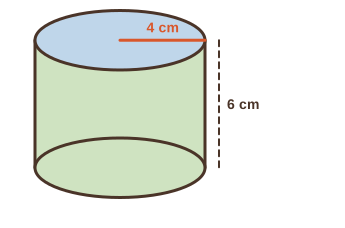 A cylinder has radius 4 cm and height 6 cm. What is its volume in cubic centimeters? (Use 3.14 for π.)
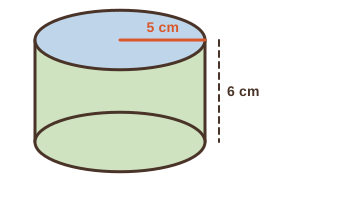 A cylinder has radius 5 cm and height 6 cm. What is its volume in cubic centimeters? (Use 3.14 for π.)
| Statement | True or false? |
|---|---|
| A cylinder's volume is its base area times its height. | ? |
| The radius is the distance all the way across the top. | ? |
| Volume is measured in cubic units. | ? |
| Doubling the height of a can doubles its volume. | ? |
Halve the width for the radius. Work out the volume with 3.14 and write it in cubic centimeters.
The tank holds a number now. Tomorrow a paper cone and a ball join it, and pouring reveals a surprise.