Tuesday
Tuesday: The Coordinate Rule
Raven tapes a fresh grid to the Blueprint Table. "Rocket, dilate this triangle by 3 without the flashlight."
Rocket frowns at point B at (2, 1). "No bulb, no shadow. How do I know where B lands?"
"What do you notice about A yesterday?" Raven asks. "A was (1, 1). With k = 2, A′ was (2, 2)."
"Both coordinates doubled," Rocket says slowly. "So with 3, every coordinate triples. B′ is (6, 3)!"
Nova hovers over the grid, her light tracing a line from the origin through B to B′. "Same line," she says.
"Three times as far from the origin, along the same line," Raven says. She plots the whole image.
Nova hums. "Now try a scale factor smaller than 1. Predict before you plot."
Multiply every coordinate by k
A dilation from the origin by scale factor k has the rule (x, y) to (kx, ky). Both coordinates are multiplied by k.
Each image point sits on the line from the origin through the original point, k times as far out.
For k = 3: (2, 1) to (6, 3). For k = 0.5: (4, 6) to (2, 3). For k = 1: nothing moves.
| Point | k = 2 | k = 3 | k = 0.5 |
|---|---|---|---|
| (1, 1) | (2, 2) | (3, 3) | (0.5, 0.5) |
| (2, 1) | (4, 2) | (6, 3) | (1, 0.5) |
| (4, 6) | (8, 12) | (12, 18) | (2, 3) |
| (-2, 4) | (-4, 8) | (-6, 12) | (-1, 2) |
- Write the coordinates of every corner of the original figure.
- Multiply each x by k and each y by k.
- Plot the new corners and connect them in the same order.
- Check: each new side should be k times its old side.
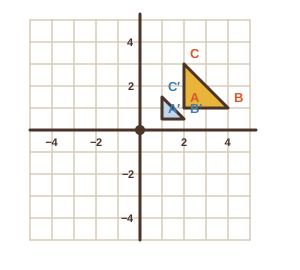
A scale factor of 0.5 pulls every corner halfway back toward the origin. The image is half the size.
- Read the question.
- Tap your answer.
- Read the question.
- Tap your answer.
- Read the question.
- Tap your answer.
The rule (kx, ky) dilates any figure. Tomorrow is Build Lab: measure how the flashlight sets the scale factor.