Monday
Monday: The Shadow on the Wall
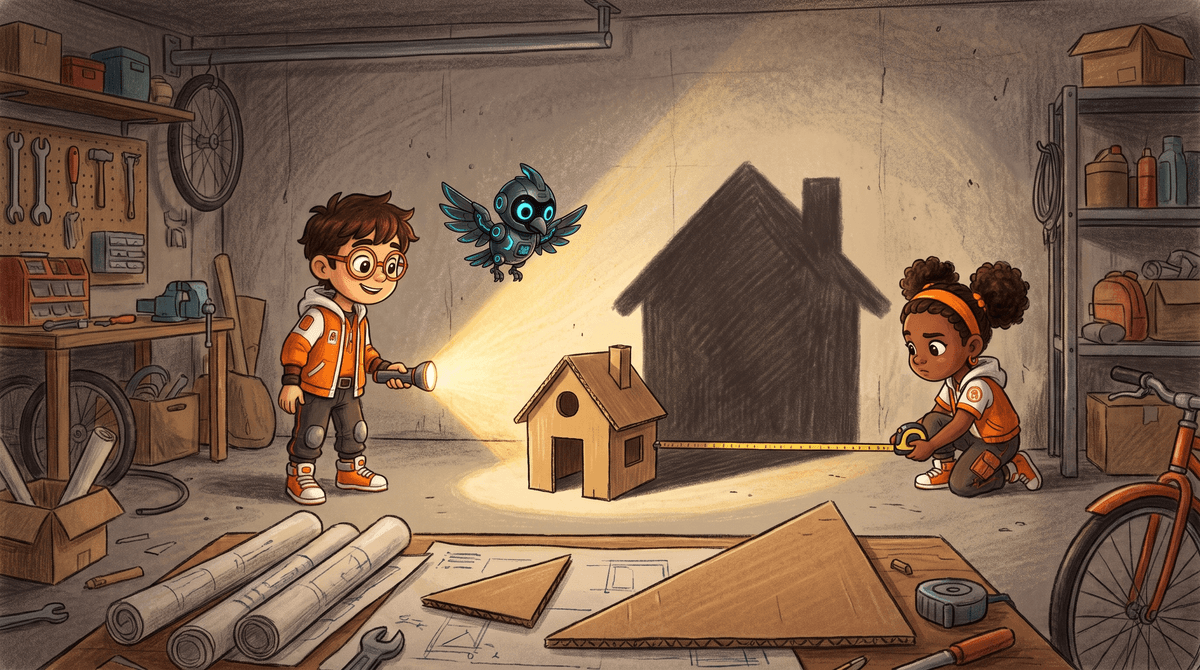
Rocket clicks on the flashlight and holds a cardboard triangle in the beam. "Look! A giant triangle on the wall."
He slides the cutout closer to the light. The shadow grows. He slides it back, and the shadow shrinks.
"What do you notice about the shape?" Raven asks. She traces the shadow on paper taped to the wall.
"Same shape, bigger size," Rocket says. "Every side got longer, but the corners look the same."
Nova hovers beside the wall, her light dim so it does not fight the beam. "Measure one side on each," she says.
Raven measures twice. "The cutout side is 4 centimeters. The shadow side is 12. What do you notice?"
"Three times!" Rocket says. Nova hums. "Check the other sides before you name the number."
A dilation has a center and a scale factor
The shadow is a dilation of the cutout. The flashlight bulb is the center, and every length grows by the same factor.
That factor is the scale factor, k. Rocket's shadow side was 12 cm from a 4 cm side, so k = 12 ÷ 4 = 3.
A scale factor bigger than 1 enlarges. A scale factor between 0 and 1 shrinks. A scale factor of 1 changes nothing.
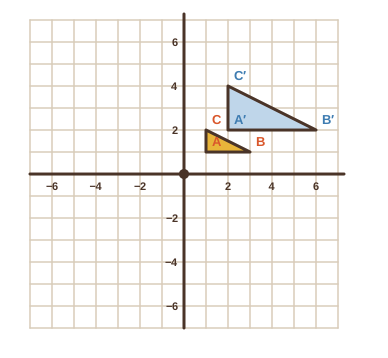
On the grid, the crew uses the origin as the center. Here triangle ABC is dilated by 2.
Every corner lands twice as far from (0, 0). A (1, 1) goes to A′ (2, 2), and B (3, 1) goes to B′ (6, 2).
Reading the scale factor
To find k, pick one side of the original and its matching side on the image. Divide the new length by the old.
Check a second pair. In a true dilation every pair gives the same k, so the shape stays the same.
- Read the question.
- Tap your answer.
- Read the question.
- Tap your answer.
| Statement | True or false? |
|---|---|
| A dilation keeps the shape and changes the size. | ? |
| A scale factor of 3 makes every side three times as long. | ? |
| A scale factor of 0.5 makes a figure bigger. | ? |
| The flashlight bulb is the center of the shadow dilation. | ? |
With a grown-up, shine a flashlight so the shadow lands on the paper. Trace it, then measure one side on each.
Never shine the flashlight toward anyone's eyes.
You found the scale factor from one shadow. Tomorrow a coordinate rule does the whole dilation at once.