Thursday
Thursday: Similar Figures and the Missing Side
Raven opens the Blueprint Book to the model clubhouse front wall. "Twelve wide, eight tall, a door and a window."
"The full-size cardboard clubhouse should be five times bigger," Rocket says. "So I multiply everything by five?"
"What do you notice if you only multiply the width?" Raven asks. Rocket sketches it. "A squashed clubhouse. Ugly."
"Every length by five," he says. "Then the big wall and the model wall are the same shape. Similar."
Nova hovers over the two drawings, her light jumping from corner to corner. "Compare the angles," she says.
"All corners still square," Rocket says. "Ninety degrees in both. And every side is five times."
Nova hums. "Equal angles, one ratio for all the sides. That is what similar means."
What similar means
Two figures are similar when one can be moved onto the other by slides, flips, turns and a dilation.
The moves keep the shape. The dilation changes the size. So similar figures have equal matching angles.
Matching sides all share one ratio, the scale factor. Each big side is k times the small side it matches.
Finding a missing side
Find k from one pair of matching sides: k = big ÷ small. Then any missing side is k times its match.
Model door 2 cm wide, full-size door 10 cm wide: k = 5. A model window of 3 cm becomes 3 × 5 = 15 cm.
These are the crew's own Blueprint Table numbers for the model wall and the full-size plan, in centimeters. The scale factor is 5.
| Part | Model (cm) | Full-size plan (cm) |
|---|---|---|
| Wall width | 12 | 60 |
| Wall height | 8 | 40 |
| Door width | 2 | 10 |
| Door height | 5 | 25 |
| Window side | 3 | 15 |
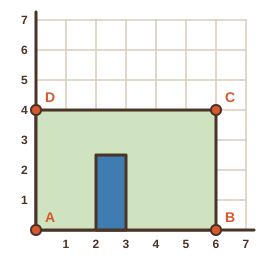
The picture shows the model wall at half size on the grid: 6 by 4 with a door 1 by 2.5. The shape is the same.
- Read the question.
- Tap your answer.
- Read the question.
- Tap your answer.
| Statement | True or false? |
|---|---|
| Similar figures have equal matching angles. | ? |
| In similar figures, every pair of matching sides has the same ratio. | ? |
| Multiplying only the width keeps a rectangle similar to the original. | ? |
| A dilation followed by a slide still gives a similar figure. | ? |
Similar figures share one ratio and all their angles. Tomorrow two angles alone prove two triangles similar.