Friday
Friday: Two Angles Are Enough
Rocket stands a 10 centimeter stick upright in the flashlight beam. Its shadow stretches up the wall.
"The bulb, the stick top and the shadow top make a triangle," Raven says. "So do the bulb, the wall and the floor."
"Two triangles, one tiny and one big," Rocket says. "Both have a square corner. Both share the angle at the bulb."
"What do you notice about the third angles?" Raven asks. Rocket thinks. "They have to match. The sum is 180."
Nova hovers at the bulb, her light tracing both triangles. "Two equal angles," she says. "Then the triangles are similar."
"So the shadow height is the stick height times the scale factor," Rocket says. "Thirty to ninety. Three times!"
Nova hums. "Enlarging photos, maps, models. Same rule everywhere. Then review the week."
The angle-angle rule
The three angles of a triangle add to 180°. If two angles of one triangle equal two angles of another, the third angles must match too.
Three matching angles mean the same shape. So two equal angles are enough to make two triangles similar.
Once two triangles are similar, their sides share one ratio, and a missing side comes from the scale factor.
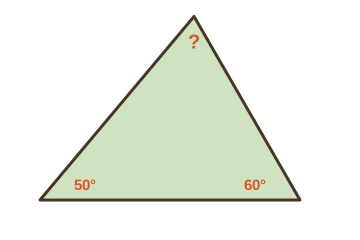
Any triangle with angles 50° and 60° has a third angle of 70°. Every such triangle is similar to this one.
Similar shapes in everyday life
A photo enlarged on a screen is a dilation: every length grows by the same factor, so faces are not squashed.
A floor plan is a shrunken copy of a room, and a model car is a shrunken copy of a car. Angles are kept, sides share one ratio.
The crew's stick: 10 cm tall, 30 cm from the bulb, wall 90 cm from the bulb. Scale factor 3, shadow 30 cm.
- Read the question.
- Tap your answer.
A triangle has angles 50° and 60°. A similar triangle has angles 50° and 60° too. What is its third angle, in degrees?- Read the question.
- Tap your answer.
| Week review | True or false? |
|---|---|
| A dilation from the origin by k sends (x, y) to (kx, ky). | ? |
| A scale factor of 2 doubles every side and every angle. | ? |
| Two triangles with two equal angles are similar. | ? |
| Similar figures must be the same size. | ? |
| In the flashlight lab, bulb-to-wall divided by bulb-to-cutout gave the scale factor. | ? |
- ?We traced a flashlight shadow and named the scale factor.
- ?We dilated points with the rule (kx, ky).
- ?We measured how distances from the bulb set the scale factor.
- ?We enlarged the clubhouse wall and found missing sides with one ratio.
- ?We proved two triangles similar from two equal angles.
Measure one matching pair of lengths on each and write the scale factor.