Week 09 · Slides, Flips and Turns
Build Day
Build Day: The floor pattern
// Moving a shape without changing it
⏱ about 20 min
Build Day: The Floor Pattern
Saturday at the Blueprint Table, the clubhouse floor lies flat with a grid drawn on it. Rocket holds a stack of L-tiles.
"Rule first," Raven says. "Pick the moves, write the corners, then tape."
"Tile one at A (1, 1)," Rocket says. "Tile two is tile one slid 2 right. Tile three is tile two flipped."
"What do you notice when they meet?" Raven asks. Rocket lays them down. "No gaps. Every tile is the same tile."
Nova hovers over the floor, her light sweeping the pattern. "Congruent, all of them," she says. "Write the sequence in the book."
Rocket writes: slide, flip, slide, flip. Nova hums. "Now tape, and nobody steps on the floor until it dries."
- A translation slides, a reflection flips, a rotation turns. The result is the image.
- Rules: slide (x + a, y + b); flip (x, -y) or (-x, y); quarter turn (-y, x); half turn (-x, -y).
- Every move keeps lengths, angles and parallel sides the same, so the image is congruent to the original.
- Two figures are congruent when a sequence of slides, flips and turns lands one on the other.
- The crew's floor pattern is one L-tile repeated by slides and flips.
◇ FAMILY FLOOR PATTERN
Together, cut six paper L-tiles the same size. A grown-up cuts any cardboard ones.
Draw a grid on the clubhouse floor or a big sheet of paper. Place tile one and write its corners.
Each person chooses the next move: a slide, a flip or a turn. Write the rule, predict the corners, then place the tile.
Check that every tile is congruent: lay tile one on each of the others. Then tape the pattern down.
Draw a grid on the clubhouse floor or a big sheet of paper. Place tile one and write its corners.
Each person chooses the next move: a slide, a flip or a turn. Write the rule, predict the corners, then place the tile.
Check that every tile is congruent: lay tile one on each of the others. Then tape the pattern down.
For a grown-up
This week your student learned translations, reflections and rotations, their coordinate rules, and congruence.
Ask them what a flip changes and what it keeps. The answer should include lengths, angles and parallel sides.
You cut the cardboard tiles with scissors and push any paper fasteners. Tape every grid flat.
Ask them what a flip changes and what it keeps. The answer should include lengths, angles and parallel sides.
You cut the cardboard tiles with scissors and push any paper fasteners. Tape every grid flat.
Safety first
A grown-up cuts cardboard with scissors. Students cut paper, sitting down.
Tape the grid and the tiles down flat. Nobody walks on the floor pattern until the tape is pressed down.
Tape the grid and the tiles down flat. Nobody walks on the floor pattern until the tape is pressed down.
BUILD DAY CHECK
- Read the question.
- Tap your answer.
Tile one has corner A at (1, 1). Tile two is tile one slid 2 right. Where is A′?
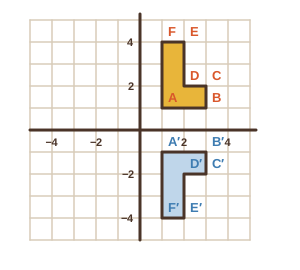 Which move takes the gold figure to the blue figure?
Each L-tile covers 4 square units. After a half turn, how many square units does the image cover?
A triangle tile sits at (1, 1), (4, 1), (1, 3). Its image is at (3, -1), (6, -1), (3, -3). Which sequence takes it there?
Congruent tiles are the same size. A sequence is just moves done one after another.
| Build Day check | True or false? |
|---|---|
| Every tile in the pattern is congruent to tile one. | ? |
| A flipped tile covers less floor than the original. | ? |
| Slide, flip, slide, flip is a sequence of moves. | ? |
WHY THIS EXERCISEThe floor pattern works because every move keeps the tile exactly the same.
Draw your family's floor pattern on a grid. Write the move between each pair of tiles.
Great building, crew. Next week: dilations and similar figures, and a shadow that grows the clubhouse.