Tuesday
Tuesday: C Equals Pi Times d
Raven pins a card to the Blueprint Table: C = π × d. "One formula for every round thing."
"And if I only know the radius?" Rocket asks, holding the small lid by its middle.
"Then double it first," Raven says. "Or write C = 2 × π × r. What do you notice? It is the same rule."
Rocket tries the lid. "Radius 5. Two times 3.14 times 5." He works it on the pad. "31.4 centimeters."
Nova hovers over the formula card, her light steady. "Now go backward," she says. "If the string says 62.8, how wide is the circle?"
"Divide by 3.14," Rocket says slowly. "Twenty." Nova hums. "The formula runs both ways."
Two ways to write one formula
| You know | Formula | Example | Circumference |
|---|---|---|---|
| the diameter | C = π × d | d = 10 cm | 3.14 × 10 = 31.4 cm |
| the radius | C = 2 × π × r | r = 5 cm | 2 × 3.14 × 5 = 31.4 cm |
| the circumference | d = C ÷ π | C = 62.8 cm | 62.8 ÷ 3.14 = 20 cm |
Both formulas say the same thing, because 2 × r is the diameter. Pick the one that matches what you measured.
Always use 3.14 for π in this course. Write the units: centimeters for a length around, never square centimeters.
- Write down what you know: radius or diameter, with units.
- If you have the radius, double it to get the diameter, or use 2 × π × r.
- Multiply by 3.14.
- Check: the answer should be a little more than three diameters.
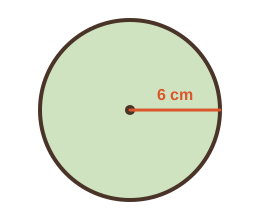
Check the picture: radius 6 cm, so diameter 12 cm. C = 2 × 3.14 × 6 = 37.68 cm. Three twelves are 36, and 37.68 is a little more. It checks.
- Read the question.
- Tap your answer.
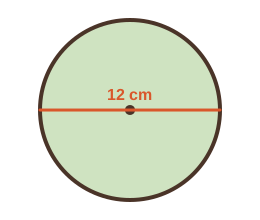 A circle has diameter 12 cm. What is its circumference in centimeters? (Use 3.14 for π.)
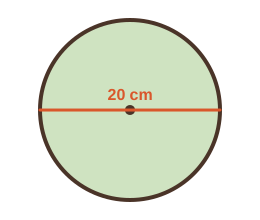 A circle has diameter 20 cm. What is its circumference in centimeters? (Use 3.14 for π.)
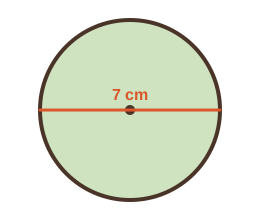 A circle has diameter 7 cm. What is its circumference in centimeters? (Use 3.14 for π.)
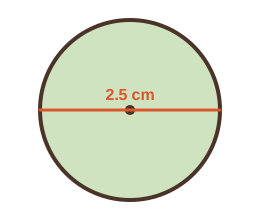 A circle has diameter 2.5 cm. What is its circumference in centimeters? (Use 3.14 for π.)
- Read the question.
- Tap your answer.
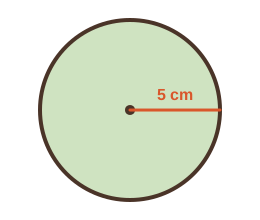 A circle has radius 5 cm. What is its circumference in centimeters? (Use 3.14 for π.)A circle has radius 6 cm. What is its circumference in centimeters? (Use 3.14 for π.)
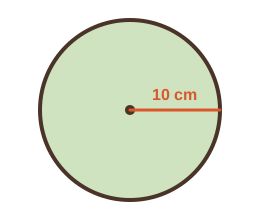 A circle has radius 10 cm. What is its circumference in centimeters? (Use 3.14 for π.)
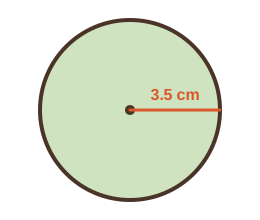 A circle has radius 3.5 cm. What is its circumference in centimeters? (Use 3.14 for π.)
- Read the question.
- Tap your answer.
| Statement | True or false? |
|---|---|
| 3.14 × 10 = 31.4 | ? |
| 2 × 3.14 × 4 = 25.12 | ? |
| 3.14 × 6 = 37.68 | ? |
| The circumference is a little more than three diameters. | ? |
Then wrap the string and compare. How close was each prediction?
String stays on the table for measuring, never around anyone's neck.
Two formulas, one idea. Tomorrow is Build Lab: string around every round thing in the garage.