Monday
Monday: A Little More Than Three
Rocket sets an empty can on the Blueprint Table. "The clubhouse needs a round window. This can is the size."
"How much cardboard edge goes around it?" Raven asks. "Measure before you cut."
Rocket wraps string around the can and marks it. He lays the string flat beside the ruler. "About 25 centimeters."
"And straight across the top?" Raven asks. Rocket measures. "8 centimeters. What do you notice?"
"Three eights are 24," Raven says. "The string is a little more than three times across."
Nova hovers over the can, her light tracing its rim. "Try the lids," she says. "See if the same thing happens."
Rocket is already reaching for the lid jar. Nova hums. "Measure twice. Then tell me the number."

The parts of a circle
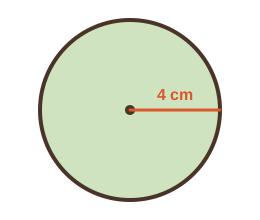
A circle is every point the same distance from one center point. That distance is the radius, r.
The diameter, d, goes straight across through the center. It is two radii end to end, so d = 2 × r. A radius of 4 cm means a diameter of 8 cm.
The circumference, C, is the distance all the way around. That is what the string measured.
Pi: the same for every circle
The crew's can: string 25.2 cm, diameter 8 cm. Divide: 25.2 ÷ 8 = 3.15. A little more than 3.
Every circle gives the same answer, big or small. That number is called pi, written π. It is a little more than 3.
Pi never comes out even, so this course uses 3.14 for π. Every circle question will remind you.
Worked example: a lid with diameter 10 cm. C = π × d = 3.14 × 10 = 31.4 cm. About three diameters and a bit more.
- Read the question.
- Tap your answer.
- Read the question.
- Tap your answer.
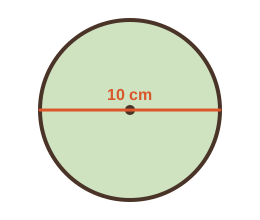 A circle has diameter 10 cm. What is its circumference in centimeters? (Use 3.14 for π.)
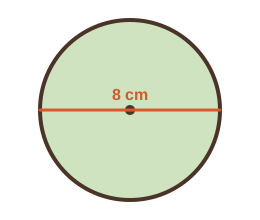 The can has diameter 8 cm. Using 3.14 for π, what circumference should the string show, in centimeters?
Lay the string flat along a ruler. Then measure straight across the top. Divide the first number by the second.
String is for measuring. Keep it off necks and away from children under three.
A little more than three, every time. Tomorrow you turn that into two formulas and size the window.