Wednesday
Wednesday: Build Lab, Cut and Count
Raven spreads grid paper across the Blueprint Table. "Build Lab. We test every formula with scissors and squares."
"Cut a parallelogram, predict its area, slide it into a rectangle, count," Rocket says. "Then triangles."
"Predict first," Raven says. "Then count. What do you notice if they disagree?"
"Then I counted wrong," Rocket says. "Or the formula is wrong." He grins. "I know which one."
Nova hovers above the stack of cut paper. "Write the prediction before you cut," she says. "A guess after counting is not a prediction."
Rocket draws a parallelogram five squares long and three tall. He writes 15 at the top and reaches for the scissors.
Your mission
Cut four shapes from grid paper: two parallelograms and two triangles. Predict each area with a formula, then count the squares to check.
- Two or three sheets of grid paper (centimeter squares work best).
- Scissors, a pencil, a ruler and masking tape.
- Your Blueprint Book for the data table.
Tape scraps into the Blueprint Book, not onto the floor where they can slip.
- Draw a parallelogram on the grid, 5 squares along the base and 3 squares tall. Write your predicted area.
- Cut it out. Cut straight down along the height from one top corner. Slide the triangle across and tape it.
- Count the squares of the rectangle. Write the count beside your prediction.
- Draw a triangle with base 6 and height 4. Predict ½ × 6 × 4. Cut two copies and fit them into a parallelogram.
- Count the parallelogram's squares and halve the count. Compare with your prediction.
- Repeat with a parallelogram of base 7, height 2, and a triangle of base 5, height 2.
The crew's lab table
These are the crew's own cuts and counts, written in Raven's Blueprint Book.
| Shape | Base | Height | Predicted area | Squares counted |
|---|---|---|---|---|
| parallelogram | 5 | 3 | 15 | 15 |
| parallelogram | 7 | 2 | 14 | 14 |
| triangle | 6 | 4 | 12 | 12 |
| triangle | 5 | 2 | 5 | 5 |
Every count matched its prediction. The parallelogram of base 5 and height 3 slid into a 5 by 3 rectangle: 15 squares.
Two triangles of base 6 and height 4 made a parallelogram of 24 squares, so each triangle was 12.
- Read the question.
- Tap your answer.
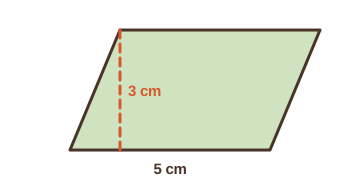 The crew's first parallelogram had base 5 and height 3. How many squares did it cover?
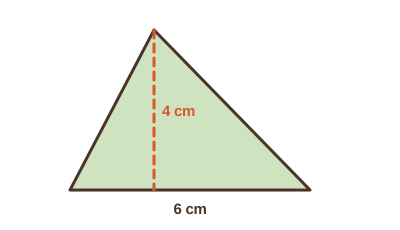 Two triangles of base 6 and height 4 made a parallelogram. How many squares did one triangle cover?
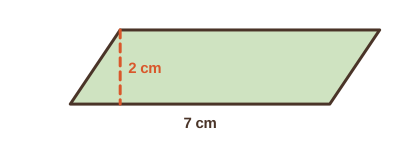 The second parallelogram had base 7 and height 2. How many squares did it cover?
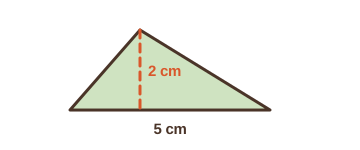 The last triangle had base 5 and height 2. How many squares did it cover?
| What the lab shows | True or false? |
|---|---|
| Sliding the cut-off triangle across changed the number of squares. | ? |
| Two copies of a triangle made a parallelogram with twice the triangle's area. | ? |
| 5 × 3 = 15 | ? |
| A prediction written after counting is still a prediction. | ? |
Every formula survived the scissors. Tomorrow the crew adds up the whole clubhouse floor, piece by piece.