Thursday
Thursday: The Floor Plan
Rocket unrolls the clubhouse floor plan across the Blueprint Table. "Four rooms. Four shapes. One big area."
"A rectangle, a triangle, a trapezoid and a parallelogram," Raven reads. "All measured in centimeters, on the model."
"What do you notice about the storage corner?" she asks, pointing at an L shape.
Rocket frowns. "It is not any of our shapes." Then he brightens. "But it is two rectangles."
Nova hovers over the L, her light drawing a line across it. "Cut it in your head," she says. "Then add."
"Decompose," Raven says. "Cut it into pieces you know, find each area, add them up."
Rocket is already writing. "Six by two, plus three by three. Twenty-one squares." Nova hums. "Now the whole floor."
Decompose any polygon
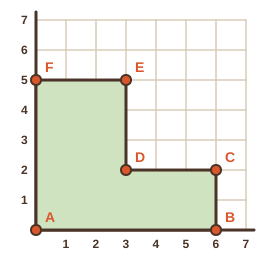
Any polygon can be cut into rectangles and triangles. Find each piece's area and add them. This is called decomposing.
The L shape is a 6 by 2 rectangle below a 3 by 3 square. Its area is 12 + 9 = 21 square units.
You can also cut it the other way: a 3 by 5 rectangle beside a 3 by 2 rectangle. The total is the same.
Raven's floor plan table
The crew's own measurements of the model clubhouse floor, in centimeters, from Raven's Blueprint Book.
| Room | Shape | Measurements (cm) | Area (sq cm) |
|---|---|---|---|
| Main room | rectangle | base 30, height 20 | 600 |
| Porch | triangle | base 20, height 12 | 120 |
| Side room | trapezoid | top 10, bottom 20, height 8 | 120 |
| Entry | parallelogram | base 10, height 6 | 60 |
The main room is 30 × 20 = 600. The porch triangle is ½ × 20 × 12 = 120.
Add all four rooms and the whole floor is 900 square centimeters of cardboard.
- Read the question.
- Tap your answer.
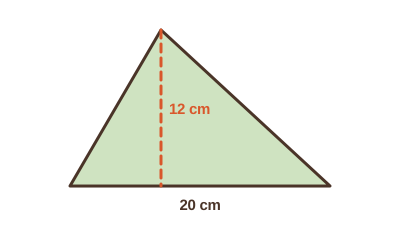 The porch is a triangle with base 20 cm and height 12 cm. What is its area in square centimeters?
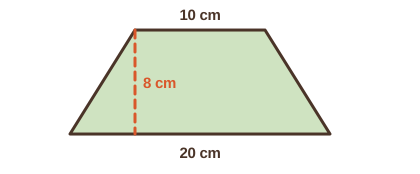 The side room is a trapezoid: top 10, bottom 20, height 8 cm. What is its area in square centimeters?
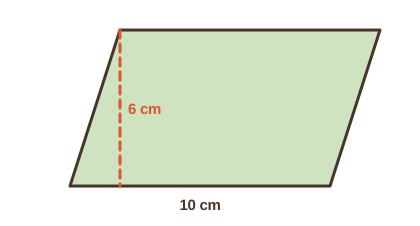 The entry is a parallelogram with base 10 cm and height 6 cm. What is its area in square centimeters?
- Read the question.
- Tap your answer.
What is the area of the polygon in square units?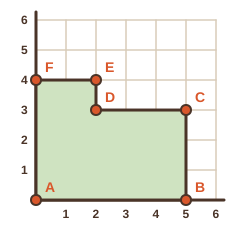 Nova draws another L: a 5 by 3 rectangle with a 2 by 1 piece on top. What is its area in square units?
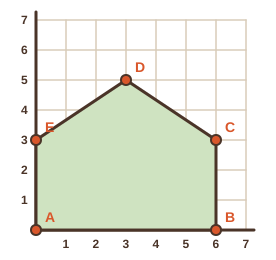 The clubhouse end wall is a rectangle with a triangle roof on top. What is its area in square units?
| From the floor plan | True or false? |
|---|---|
| An L shape can be cut into two rectangles. | ? |
| Cutting the L shape a different way gives a different area. | ? |
| 12 + 9 = 21 | ? |
| The whole floor area is the sum of the four room areas. | ? |
Find the area each way. Write both in your Blueprint Book and compare.
Four rooms, one total. Tomorrow you find cut-and-compose shapes all around you and review the week.