Monday
Monday: Every Prop Is a Shape
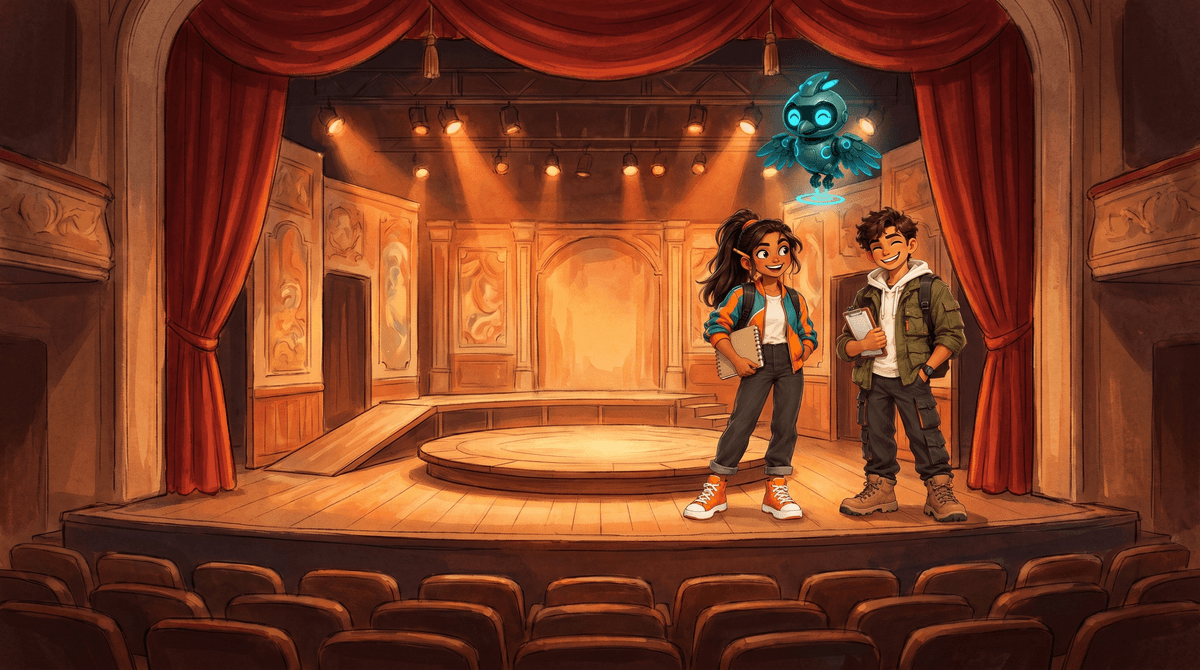
Comet stands on the finished set under the work lights. "Opening Night is Saturday. Everything we built is out here."
Wren walks the stage with the clipboard. "Column, stair unit, ramp, turntable, backdrop, honeycomb panel. What do you notice?"
"Every one of them is a shape we know," Comet says. "The column is a cylinder. The stair unit is a box."
"The ramp side is a right triangle. The turntable is a circle," Wren adds. "And the lamp dish is a parabola."
Nova hovers above the turntable and projects a shape over each prop. "Would you like a hint? A model keeps what matters and drops the rest."
"The column has a chip in it," Comet says. "The cylinder does not care. What can we make with that?"
"A whole set, on paper, with numbers," Wren says. "Our designer, model every piece."
Modeling: pick the shape, keep the measures
A real prop is never a perfect shape. A model is the simple shape closest to it, with the few measurements that matter.
The column has a chip and a seam. As a cylinder it has only a radius and a height, and that is enough to find its volume.
| Piece of the set | Model | Measures (crew's own) | What we can compute |
|---|---|---|---|
| column | cylinder | r = 20 cm, h = 90 cm | volume of foam |
| stair unit | box | 120 by 50 by 20 cm | volume of foam |
| ramp side | right triangle | base 240 cm, height 40 cm | area of plywood |
| backdrop | rectangle | 6 m by 4 m | area of fabric |
| honeycomb tile | regular hexagon | side 10 cm, apothem 8.7 cm | area of one tile |
| turntable | circle | radius 5 grid units | equation on the stage grid |
A solved problem to study
Wren models the ramp side. It is a right triangle with base 240 cm and height 40 cm. The top edge is the slope.
Area: half of 240 × 40 = 4,800 square centimeters. That is how much plywood each side needs.
Then the stair unit as a box: 120 × 50 × 20 = 120,000 cubic centimeters of foam.
Why does this work? Once the shape is chosen, the formula does the rest. The hard part is choosing well and measuring carefully.
- Read the question.
- Tap your answer.
- Read the question.
- Tap your answer.
 The ramp side is a right triangle with base 240 cm and height 40 cm. What is its area in square centimeters?
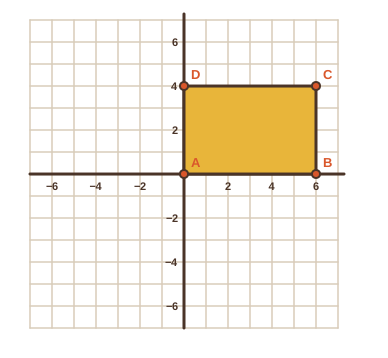 The backdrop is a rectangle 6 m by 4 m. What is its area in square meters?
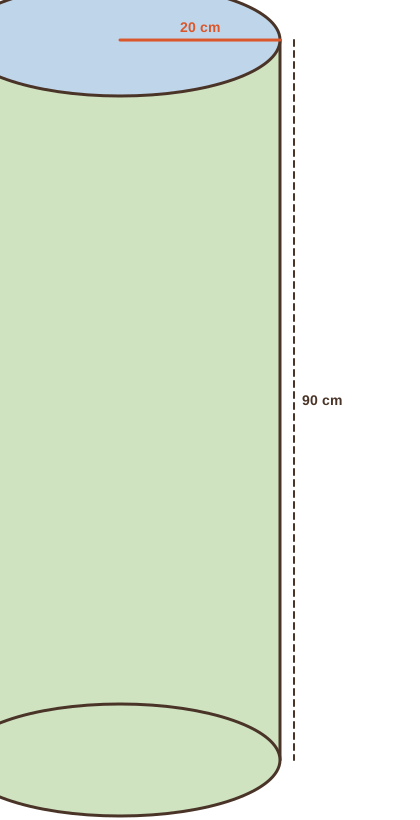 The column is a cylinder with radius 20 cm and height 90 cm. What is its volume in cubic centimeters? Use 3.14 for π.
| Statement | True or false? |
|---|---|
| A model keeps the measures that matter and drops small details like a chip. | ? |
| A chipped column cannot be modeled as a cylinder. | ? |
| The ramp side is modeled as a right triangle. | ? |
| The backdrop is modeled as a sphere. | ? |
| The stair unit holds more foam than the column. | ? |
For one of them, measure what you need and compute its area or volume.
Strong modeling, designer. Tomorrow the crew counts sheets, cups and seats per unit of space: density.