Tuesday
Tuesday: Hidden Centers
Wren holds up a page from last season's shop notes. "The old turntable equation. x² + y² - 6x - 4y - 12 = 0."
"That is not a circle," Comet says. "There are no squares with a center in them."
"It is the same circle, multiplied out," Wren says. "What do you notice about the -6x?"
"Six is twice three," Comet says slowly. "And the -4y, four is twice two. The center is hiding in those numbers."
Nova projects x² - 6x with a blank box after it. "Would you like a hint? What number makes this a perfect square?"
"Nine. (x - 3)² is x² - 6x + 9," Comet says. "And four for the y part. Then the 12 moves across."
"Nine plus four plus twelve," Wren says. "Twenty-five. Radius 5. Our designer, this trick is called completing the square."
From the expanded form to the center
An equation like x² + y² + Dx + Ey + F = 0 is a circle written out. The center and radius are hidden.
Completing the square puts them back. Half of D, squared, finishes the x square. Half of E, squared, finishes the y square.
- Group the x terms and the y terms, and move the plain number to the right side.
- Take half of the x coefficient, square it, and add it to both sides.
- Take half of the y coefficient, square it, and add it to both sides too.
- Write each group as a perfect square: (x - h)² + (y - k)² = r².
- Read the center (h, k) and take the square root of the right side for r.
The turntable, worked through
Start: x² + y² - 6x - 4y - 12 = 0. Move the 12: x² - 6x + y² - 4y = 12.
Half of -6 is -3, squared is 9. Half of -4 is -2, squared is 4. Add both: x² - 6x + 9 + y² - 4y + 4 = 12 + 9 + 4.
So (x - 3)² + (y - 2)² = 25. Center (3, 2), radius 5. The same turntable as Monday.
| Circle | Center and radius form | Expanded form | Center | Radius |
|---|---|---|---|---|
| turntable | (x - 3)² + (y - 2)² = 25 | x² + y² - 6x - 4y - 12 = 0 | (3, 2) | 5 |
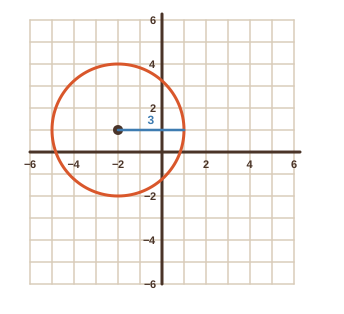
| spotlight pool | (x + 2)² + (y - 1)² = 9 | x² + y² + 4x - 2y - 4 = 0 | (-2, 1) | 3 |
| trap circle | x² + y² = 16 | x² + y² - 16 = 0 | (0, 0) | 4 |
Both forms describe the same points. The first form shows the center and radius. The expanded form is what you get after multiplying out.
Watch the signs: (x + 2)² means the center has x = -2, because x + 2 is x - (-2).
- Read the question.
- Tap your answer.
- Read the question.
- Tap your answer.
- ?Add 4 to both sides to finish the x square: x² + 4x + 4 + y² - 2y = 8
- ?Group: x² + 4x + y² - 2y = 4
- ?Write the squares: (x + 2)² + (y - 1)² = 9
- ?Add 1 to both sides to finish the y square: x² + 4x + 4 + y² - 2y + 1 = 9
- ?Read the center (-2, 1) and the radius 3
Clean work, designer. Tomorrow is Shop Lab: chalk, tape and the Pythagorean check on the real floor.