Monday
Monday: The Turntable Has an Equation
Comet pours paint into a tray beside the foam props. "Turntable gets its first coat today. Then the pyramid, the cone, the sphere."
Wren is on the stage with the tape measure and the chalk. "The grid is taped. The turntable center is at (3, 2)."
"Radius 5," Comet says, setting down the can. "What can we make of that? A circle is just points."
"Points that are all 5 from the center," Wren says. "What do you notice about the point (6, 6)?"
"Over 3, up 4 from the center. A 3-4-5 triangle. It is exactly 5 away, so it is on the circle."
Nova projects a right triangle from the center to the point. "Would you like a hint? Every point on the circle makes one."
"Then every point obeys the Pythagorean theorem," Comet says. "Our designer, write the rule all of them share."

A circle is a distance rule
The turntable's center is at (3, 2) and its radius is 5 grid units. These are the crew's own stage measurements.
A point (x, y) is on the circle exactly when its distance from the center is 5. Distance comes from the Pythagorean theorem.
The legs of the right triangle are x - 3 and y - 2. So (x - 3)² + (y - 2)² = 25.
In general, the circle with center (h, k) and radius r is (x - h)² + (y - k)² = r². For the turntable: (x - 3)² + (y - 2)² = 25.
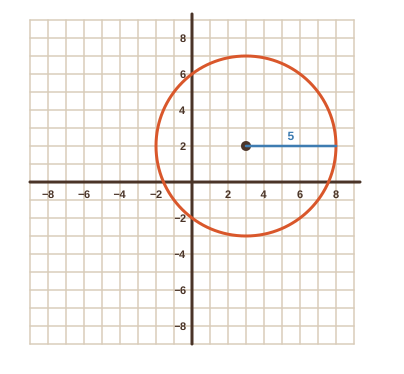
A solved problem to study
Wren checks whether (6, 6) is on the turntable. Here is his work.
Change in x: 6 - 3 = 3. Change in y: 6 - 2 = 4. Squares: 25. That equals r², so the point is on the circle.
Then he tries (6, 5). Squares: 18, not 25. That point is inside the circle, a little short of the edge.
Why does this work? The equation is the distance rule in disguise. Put a point in, and the left side is its squared distance from the center.
- Read the question.
- Tap your answer.
The turntable has center (3, 2) and radius 5. Which equation describes it?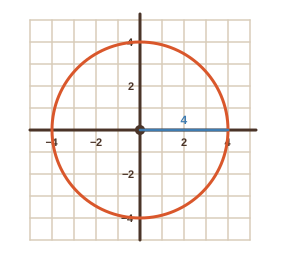 The trap circle is centered at the origin with radius 4. Which equation describes it?
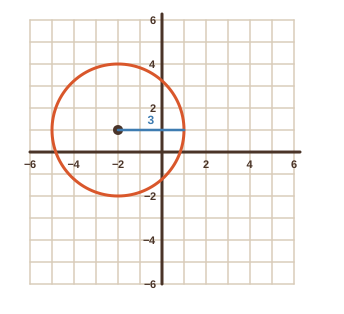 The spotlight pool has center (-2, 1) and radius 3. Which equation describes it?
- Read the question.
- Tap your answer.
How far is (6, 6) from the turntable center (3, 2)?How far is (-1, -1) from the turntable center (3, 2)?How far is (6, 5) from the center (3, 2)? Round to 2 decimal places.| Statement | True or false? |
|---|---|
| The point (8, 2) is on the circle with center (3, 2) and radius 5. | ? |
| The point (3, 8) is on the circle with center (3, 2) and radius 5. | ? |
| The point (0, 6) is on the circle with center (3, 2) and radius 5. | ? |
| The equation of a circle comes from the Pythagorean theorem. | ? |
| In (x - 3)² + (y - 2)² = 25, the radius is 25. | ? |
Pick any grid point on the circle and draw the right triangle to the center. Check that the legs are 3 and 4, or 5 and 0.
Strong start, designer. Tomorrow an equation hides its center, and you complete the square to find it.