Wednesday
Wednesday: Shop Lab, the Angle Finder
Comet sets a protractor, a straw, a piece of string and a metal washer on the bench. "Lab day. We build angle finders."
"The backdrop frame is too tall to measure with the tape," Wren says. "So we measure the angle instead."
Comet tapes the straw along the flat edge of the protractor and hangs the washer from the center hole. "Done."
She backs up 6 meters, sights the top of the frame through the straw, and Wren reads the string. "35 degrees."
"That angle is the angle of elevation," Wren says. "Distance times tangent gives the height above your eye."
Nova projects the triangle from Comet's eye to the frame top. "Would you like a hint? Add the height of your eye at the end."
"Our designer, build one, then measure something tall at home," Comet says. "Three distances, three readings. Compare."
What you need
- A protractor, a drinking straw, about 30 centimeters of string, a metal washer or any small weight, and tape.
- A tape measure or meter stick, and a helper to read the string while you sight.
- Something tall and safe to measure: a doorframe, a bookshelf, a wall, or a tree in the yard.
- Your Shop Book and the trig table from Tuesday.
Sight along the straw, never at the Sun. Keep the string clear of your face.
A grown-up holds any ladder in the Scene Shop, and nothing heavy is lifted alone.
Build and use the angle finder
- Tape the straw along the flat edge of the protractor so you can sight through it.
- Tie the washer to the string and tape the other end to the center mark of the protractor.
- Measure your eye height while standing. Write it in your Shop Book.
- Stand a measured distance from the tall object. Sight its top through the straw and hold still.
- Have your helper read where the string crosses the scale. Subtract that reading from 90° to get the angle of elevation.
- Height = distance × tan(angle) + eye height. Repeat from two more distances and compare.
Why subtract from 90°? The string hangs straight down, so it marks 90° when the straw is level.
Tilt the straw up by some angle and the string reading drops by that same angle.
The crew's lab log
Here are the crew's own sightings of the backdrop frame top. Comet's eye height is 1.5 meters. All made-up Scene Shop data.
| Distance (m) | Angle of elevation | tan(angle) | Distance × tan (m) | Height (m) |
|---|---|---|---|---|
| 4 | 46° | 1.036 | 4.1 | 5.6 |
| 6 | 35° | 0.7 | 4.2 | 5.7 |
| 8 | 28° | 0.532 | 4.3 | 5.8 |
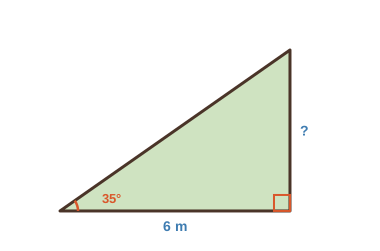
From 6 meters: 6 × tan 35° = 6 × 0.7 = 4.2, plus 1.5 gives 5.7 meters.
The three heights are close but not equal. Reading a string to the nearest degree always leaves a little spread.
- Read the question.
- Tap your answer.
From 6 meters the angle of elevation was 35°. How far above eye level is the frame top, in meters, to 1 decimal place?| What the lab shows | True or false? |
|---|---|
| Standing farther away makes the angle of elevation smaller. | ? |
| Height = distance × tan(angle) + eye height. | ? |
| The three heights in the log came out exactly equal. | ? |
| You need to climb the frame to check its height. | ? |
Then measure the book's rise and run with a ruler and find rise ÷ run. Does the tangent match?
Fine lab work, designer. Tomorrow the crew solves three set pieces from their own Scene Shop measurements.