Thursday
Thursday: The Model Plan and the AA Criterion
Wren spreads the model plan on the bench. "Every full-size piece in one column, the one-tenth model in the next."
Comet runs down the list. "Flat 240 wide, model 24. Ramp 300 long, model 30. Easy. Divide by ten."
"Now the braces," Wren says, holding up two cardboard triangles, one small, one large. "Are these similar?"
"They look similar. But the big one has no side lengths written on it."
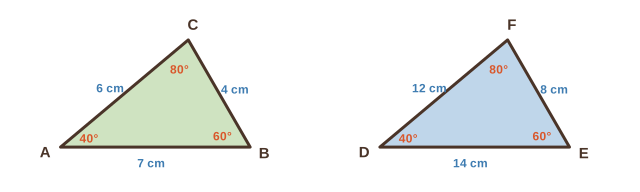
Nova projects both triangles with their angles glowing. "Would you like a hint? Count the matching angles."
"Forty and sixty on both," Comet says. "The third has to be eighty on both. All three angles match."
"Two matching angles were enough," Wren says. "That is the AA criterion. Our designer, work the plan and prove AA."
The crew's model plan
Scale factor 0.1 from the shop floor to the model. Full sizes are the crew's own plan, in centimeters.
| Piece | Full size (cm) | Model (cm) |
|---|---|---|
| Flat, width | 240 | 24 |
| Flat, height | 360 | 36 |
| Access ramp, length | 300 | 30 |
| Turntable, diameter | 200 | 20 |
| Door opening, width | 90 | 9 |
| Door opening, height | 210 | 21 |
Similar triangles
Two figures are similar when a sequence of rigid motions and dilations carries one onto the other.
For triangles this means all three pairs of corresponding angles are equal. All three pairs of corresponding sides are in the same ratio.
The crew's two braces: angles 40°, 60°, 80° in both, sides 4, 6, 7 cm and 8, 12, 14 cm. Every side ratio is 2.
Proof: the AA criterion
- Given: triangles ABC and DEF with angle A = angle D and angle B = angle E.
- Angle C = angle F, because both equal 180° minus the other two angles.
- Dilate triangle ABC from A by the factor DE divided by AB. Now A′B′ = DE, and the angles are unchanged.
- Triangle A′B′C′ and triangle DEF match in angle, side, angle, so they are congruent by ASA.
- A congruence is a sequence of rigid motions. A dilation followed by rigid motions carries ABC onto DEF: the triangles are similar.
- ?Given: two triangles with two pairs of equal angles
- ?The third angles are equal, since each is 180° minus the other two
- ?Dilate the first triangle so one side matches the corresponding side of the second
- ?The dilated triangle and the second triangle are congruent by ASA
- ?A dilation followed by rigid motions carries one triangle onto the other, so they are similar
- Read the question.
- Tap your answer.
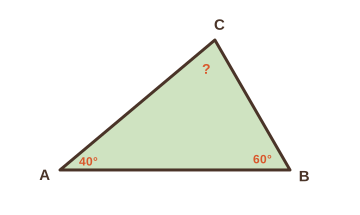 Both braces have angles of 40° and 60°. What is the third angle of each?
Plan complete, designer. Tomorrow you find similar shapes everywhere and review the week.