Friday
Friday: Similar Shapes Everywhere
Comet holds her thumb up at the far flat and closes one eye. "My thumb covers the whole flat from here."
"Your eye is the center of dilation," Wren says. "The thumb and the flat are similar in your view. What do you notice?"
"Closer things look bigger. Same shape, different scale factor. Like the flashlight."
Nova projects a photo of the set, then the same photo twice as wide. "Would you like a hint? Which is similar to the original?"
"Neither, if you only stretched it sideways," Comet says. "Both directions, or it is not a dilation."
"Right," Wren says. "A stretch changes angles. Review today, designer, and next week we measure the pole outside with its shadow."
Dilations in everyday places
| Where | Center | What stays, what changes |
|---|---|---|
| a photo enlarged on a screen | the corner you pinch from | angles stay, every length multiplies |
| a floor plan or a map | any point, chosen by the drafter | shapes stay, distances shrink by one factor |
| a shadow from one small lamp | the lamp | the shadow is the object dilated by the distance ratio |
| the scale model of the set | any point | every length is one tenth |
| a photo stretched sideways only | no center | not a dilation: angles change, so not similar |
The week in five lines
- A dilation has a center and a scale factor. Each point moves along its ray, k times as far from the center.
- A line through the center stays. A line not through the center goes to a parallel line.
- Every length is multiplied by k. Angles do not change.
- Similar figures: a sequence of rigid motions and dilations carries one onto the other.
- Similar triangles have equal angles and proportional sides. AA is enough to prove it.
- Read the question.
- Tap your answer.
- Read the question.
- Tap your answer.
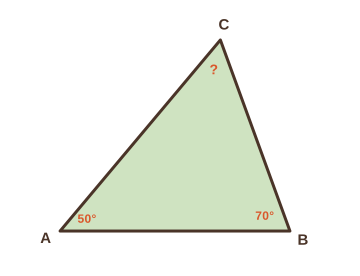 Both of those triangles have angles of 50° and 70°. What is their third angle?
| Week review | True or false? |
|---|---|
| A dilation with scale factor 3 triples every length. | ? |
| A dilation with scale factor 3 triples every angle. | ? |
| 20 × 3 = 60 | ? |
| Two squares of different sizes are always similar. | ? |
| Two rectangles of different sizes are always similar. | ? |
| A line through the center of dilation moves to a parallel line. | ? |
Find a map or a floor plan at home. Measure two lengths and check they shrink by the same factor.
Sharp review, designer. Tomorrow is Shop Day: the family builds a scale model of a room.