Tuesday
Tuesday: Parallel Rails and a Brace
Wren lays two long rails on the floor, parallel, and a brace across them. "Eight angles, one brace."
Comet sets the protractor at the top crossing. "Angle a is 70. Do I measure the other seven?"
"What do you notice about the bottom crossing?" Wren asks.
"It looks like the top one, slid down the brace." Comet slides her hand along it. "Same slant, because the rails are parallel."
Nova projects the top crossing in gold and slides the copy down to the bottom one. It fits exactly.
"Would you like a hint? A translation along the brace carries one crossing onto the other."
"Then every angle at the bottom matches one at the top," Comet says. "Our designer, prove it and fill in all eight."
Names for the eight angles
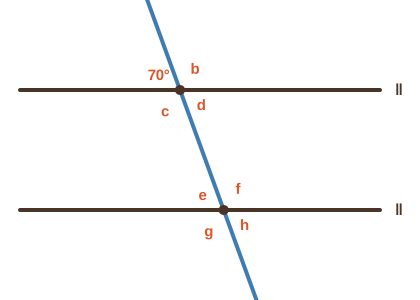
- Vertical angles: opposite at one crossing, like a and d. Congruent (Monday's theorem).
- Corresponding angles: the same spot at each crossing, like a and e. Congruent when the lines are parallel.
- Alternate interior angles: between the rails, on opposite sides of the brace, like c and f. Congruent when the lines are parallel.
- Angles along a straight line, like a and b, are supplementary: they add to 180°.
Proof: corresponding angles are congruent
Given: two parallel lines cut by a transversal. Prove: angle a is congruent to angle e.
Translate the top crossing along the transversal until it lands on the bottom crossing.
A translation is a rigid motion, so it keeps every angle. It carries the top rail onto the bottom rail because they are parallel.
So it carries angle a exactly onto angle e. Two angles related by a rigid motion are congruent. Done.
- Given: parallel lines cut by a transversal, with alternate interior angles c and f.
- Angle c is vertical with angle b, so angle c = angle b.
- Angle b corresponds to angle f, so angle b = angle f (the theorem above).
- Therefore angle c = angle f. Alternate interior angles are congruent.
Comet measured only angle a: 70°. The rest follow from the two theorems. These are the crew's own numbers.
| Angle | Measure | Reason |
|---|---|---|
| a | 70° | measured |
| b | 110° | straight line with a |
| c | 110° | straight line with a |
| d | 70° | vertical with a |
| e | 70° | corresponding to a |
| f | 110° | corresponding to b |
| g | 110° | corresponding to c |
| h | 70° | corresponding to d |
- Read the question.
- Tap your answer.
Two parallel lines are cut by a third line. Angle a is 70°. What is angle e, in degrees?Two parallel lines are cut by a third line. Angle a is 70°. What is angle f, in degrees?Two parallel lines are cut by a third line. Angle a is 70°. What is angle c, in degrees?Two parallel lines are cut by a third line. Angle a is 70°. What is angle h, in degrees?Points on a perpendicular bisector
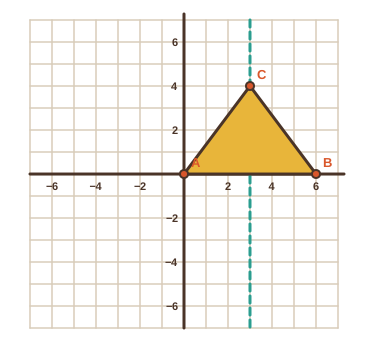
The bottom edge of a flat runs from A (0, 0) to B (6, 0). Its perpendicular bisector is the line x = 3.
Take P at (3, 4) on that line. PA is 5 and PB is 5. Equal.
Why always? The reflection over the bisector swaps A and B and leaves P alone, so PA and PB are congruent.
The converse holds too: a point equally far from A and B must sit on the bisector. Together: exactly those points.
- Read the question.
- Tap your answer.
P is at (3, 4) and A at (0, 0). How far is P from A?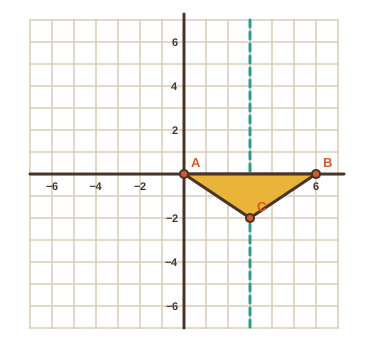 Q is at (3, -2), also on x = 3. How far is Q from B at (6, 0)?
| Statement | True or false? |
|---|---|
| Corresponding angles on parallel lines are congruent. | ? |
| All eight angles made by a transversal across parallel lines are congruent. | ? |
| 70 + 110 = 180 | ? |
| A point on the perpendicular bisector of AB is equally far from A and B. | ? |
| The proof of corresponding angles used a reflection. | ? |
Measure one angle, write all eight, then measure two more to check your table.
Eight angles from one reading, designer. Tomorrow is Shop Lab: cardboard braces, torn corners and a midsegment.