Monday
Monday: What a Proof Is For
Comet drops the big wooden frame onto the sawhorses. "The window frame for the flat. I measured it: a parallelogram."
Wren runs the tape along each side. "Opposite sides measure the same, 120 and 90. But measuring is not proving."
"What is the difference?" Comet asks. "The tape says it is a parallelogram."
"The tape says this frame is. A proof says every frame built this way must be." Wren taps the frame. "What do you notice at the corners?"
"Two sticks cross and make four angles. The opposite ones look equal."
Nova hovers over a crossing and projects the four angles in color. "Would you like a hint? Each pair along a stick makes a straight line."
Comet grins. "So the opposite angles have to match. Our designer, help us write that down so it counts."

Theorems and proofs
A theorem is a statement that has been proved. A proof is a chain of statements, each with a reason.
The reasons you may use are definitions, postulates (facts agreed without proof), and theorems proved earlier.
A two-column proof lists statements on the left and reasons on the right. A flowing proof tells the same chain as sentences.
Both start from what is given and end with what was to be proved.
- Given: the facts the problem hands you. Write them first.
- Definition: what a word means, such as "supplementary angles add to 180°".
- Postulate: a fact accepted without proof, such as "angles along a straight line add to 180°".
- Theorem: a fact proved earlier, such as "the angles of a triangle add to 180°" (after Wednesday).
A solved problem to study: vertical angles are congruent
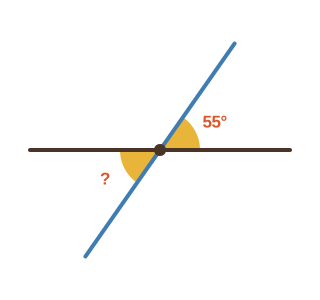
Two lines cross at a point and make angles 1, 2 and 3 in a row. Angle 2 sits between the other two.
Angles 1 and 3 are vertical angles: opposite each other at the crossing. Here is the crew's two-column proof that they are congruent.
| Statement | Reason |
|---|---|
| Angle 1 and angle 2 make a straight line. | Given: the two lines cross. |
| Angle 1 + angle 2 = 180°. | Angles along a straight line add to 180°. |
| Angle 3 + angle 2 = 180°. | Angles along a straight line add to 180°. |
| Angle 1 + angle 2 = angle 3 + angle 2. | Both equal 180°. |
| Angle 1 = angle 3. | Subtract angle 2 from both sides. |
Why does it work? Both vertical angles share the same neighbor, angle 2, along a straight line.
Each is 180° minus angle 2, so they must be equal. Nothing about the 55° mattered: the proof covers every crossing.
- Read the question.
- Tap your answer.
Two sticks of the frame cross. One angle is 55°. What is the angle opposite it, in degrees?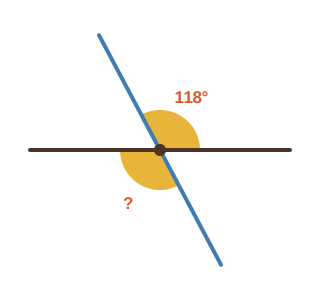 At another crossing one angle is 118°. What is its vertical angle, in degrees?
- ?Given: two lines cross, making angles 1, 2 and 3 in a row
- ?So angle 1 + angle 2 = angle 3 + angle 2
- ?Subtract angle 2 from both sides: angle 1 = angle 3
- ?Angle 1 + angle 2 = 180°, because they make a straight line
- ?Angle 3 + angle 2 = 180°, because they make a straight line too
| Statement | True or false? |
|---|---|
| A postulate is a fact accepted without proof. | ? |
| Measuring one frame proves that every frame built that way is a parallelogram. | ? |
| Vertical angles are congruent at every crossing, whatever the angle. | ? |
| 55 + 125 = 180 | ? |
| A two-column proof lists reasons on the left and statements on the right. | ? |
Measure to check. Then say out loud why the opposite angles had to match.
Strong start, designer. Tomorrow a brace crosses two parallel rails and eight angles come from one measurement.