Thursday
Thursday: The Flat Log and the Symmetry Check
Wren opens the Shop Book to a full page of coordinates. "Every corner of the flat, before and after each motion."
"Five corners, three motions, fifteen new points," Comet says. "The rules wrote them, right?"
"The rules wrote them. I checked three on the floor," Wren says. "What do you notice in the flip column?"
"Every x changed sign. Every y stayed. And in the turn column they swap."
Nova projects a rectangle flat, then spins it a half turn. It lands on itself. "Would you like a hint? Which turns do that?"
"Only the half turn for a rectangle," Comet says. "A square would have more. Our designer, count the symmetries."
Reading the log
The crew's flat log, made on the chalk grid. Each row is one corner of the flat and where it lands after each motion.
| Corner | Before | Slide (x + 3, y - 5) | Flip (-x, y) | Turn (-y, x) |
|---|---|---|---|---|
| A | (1, 1) | (4, -4) | (-1, 1) | (-1, 1) |
| B | (5, 1) | (8, -4) | (-5, 1) | (-1, 5) |
| C | (5, 3) | (8, -2) | (-5, 3) | (-3, 5) |
| D | (3, 4) | (6, -1) | (-3, 4) | (-4, 3) |
| E | (1, 3) | (4, -2) | (-1, 3) | (-3, 1) |
Read a row: corner C starts at (5, 3). The slide sends it to (8, -2), the flip to (-5, 3), the turn to (-3, 5).
Every row follows the same three rules, so the whole log can be checked one corner at a time.
Which motions carry a flat onto itself?
Some flats land exactly on themselves after a rotation or a reflection. Those motions are the figure's symmetries.
Take the rectangle flat (-3, -1), (3, -1), (3, 1), (-3, 1). A 180° turn lands it on itself. So do flips over the x-axis and the y-axis.
The square flat (-2, -2), (2, -2), (2, 2), (-2, 2) has more. Turns of 90°, 180°, 270° work, and so do 4 lines of reflection.
| Flat (centered at the origin) | Rotations under 360° | Lines of reflection |
|---|---|---|
| rectangle (not a square) | 1 (180°) | 2 (the x-axis, the y-axis) |
| square | 3 (90°, 180°, 270°) | 4 (the x-axis, the y-axis, the line y=x, the line y=-x) |
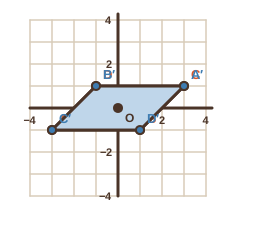
| parallelogram (not a rectangle) | 1 (180°) | 0 |
| isosceles trapezoid | 0 | 1 (the y-axis) |
For a regular polygon the count is easy. A regular n-sided flat has n lines of reflection and n - 1 rotations under 360°.
A regular hexagon turns by 60°, 120°, and so on, five times before a full turn, and has six lines of reflection.
- Read the question.
- Tap your answer.
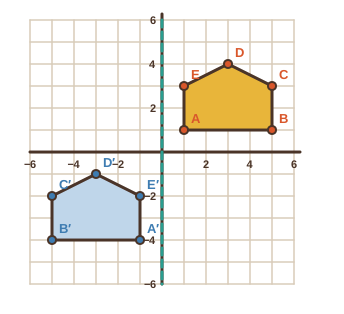 The flat has corners (1, 1), (5, 1), (5, 3), (3, 4), (1, 3). Its image has corners (-1, -4), (-5, -4), (-5, -2), (-3, -1), (-1, -2). Which sequence carries it there?
- Read the question.
- Tap your answer.
| Statement | True or false? |
|---|---|
| A half turn carries every rectangle onto itself. | ? |
| A 90° turn carries every rectangle onto itself. | ? |
| A parallelogram that is not a rectangle has no line of reflection. | ? |
| An isosceles trapezoid has exactly one line of reflection. | ? |
| A regular pentagon has 5 lines of reflection. | ? |
Count how many ways each one lands exactly on its tracing.
Fifteen new points and a symmetry table. Tomorrow you spot rigid motions around the house and review.