Monday
Monday: Two Strings, One Crossing
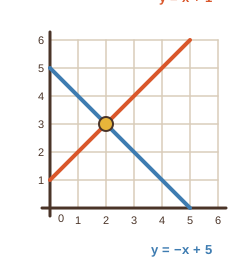
Rocket tapes a sheet of floor graph paper to the garage floor and stretches a string across it. "Line one: y = x + 1."
Raven lays a second string the other way. "Line two: y = -x + 5. What do you notice?"
"They cross," Rocket says. "Right there." He kneels. "Two across, three up. The point (2, 3)."
"Is (2, 3) on line one?" Raven asks. "2 + 1 is 3. Yes."
"And line two? Negative 2 plus 5 is 3. Yes again."
Nova hovers above the crossing, her light pooling on the one square both strings touch. "How many points fit both?"
"Just that one," Rocket says. "Every other point is on one string or the other, not both."
"Then (2, 3) solves both equations at once," Raven says. "That is this week's puzzle."

Two equations, one answer
Two equations that must both be true at once are a system. The Monday strings are one.
Each equation draws a line. The two lines cross at one point, (2, 3). That point is the solution of the system.
Check: for y = x + 1, 2 + 1 = 3. For y = -x + 5, -2 + 5 = 3. Both true.
Any other point fails at least one equation. (0, 1) is on the first line but not the second.
Why the crossing point
A point on a line makes that line's equation true. A point on both lines makes both equations true.
So the crossing point is exactly the pair (x, y) that solves both equations. Nothing else does.
If the lines cross once, the system has one solution.
- Read the crossing point from the graph as (x, y).
- Put the x and y into the first equation. Check that it is true.
- Put the same x and y into the second equation. Check again.
- If both are true, you have the solution of the system.
- Read the question.
- Tap your answer.
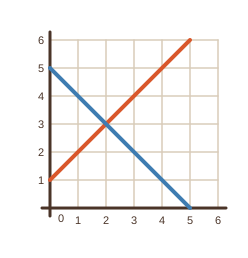 Which point makes both y = x + 1 and y = -x + 5 true?
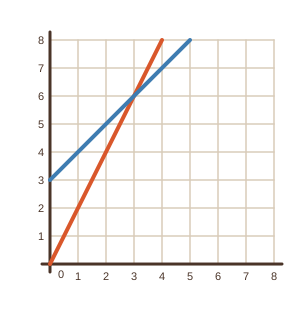 Which point makes both y = 2x and y = x + 3 true?
- Read the question.
- Tap your answer.
| Statement | True or false? |
|---|---|
| The solution of a system is the point where the two lines cross. | ? |
| (2, 3) is a solution of y = x + 1 and y = -x + 5. | ? |
| (0, 1) is a solution of y = x + 1 and y = -x + 5. | ? |
| (3, 6) is a solution of y = 2x and y = x + 3. | ? |
| 2 + 1 = -2 + 5 | ? |
Read the square where they cross. Check the point in both equations.
Tape the paper flat so no one trips, and keep shoes on in the garage.
Great start. Tomorrow you solve systems three ways: by looking, by graphing and by substitution.