Monday
Monday: The Rule Machine
Rocket sets a cardboard box on the Puzzle Post bench. It is painted orange, with a slot cut in each end.
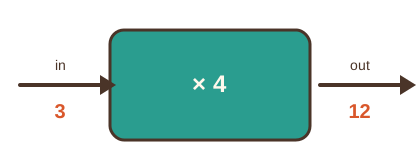
"The rule machine," he says. "A card goes in one side. A new card comes out the other."
Raven slides in a card marked 3. Rocket scribbles behind the box and pushes out a card marked 12.
"What do you notice?" Raven asks. She tries 5. Out comes 20.
"Each number in gives one number out," Rocket says. "The rule is times 4."
Nova hovers over the slot, her light steady. "Which number did you choose?" she asks. "And which one depended on your choice?"
"I chose the input," says Raven. "The output depended on it." Nova hums. "That is the whole week."

Two quantities that change together
When Raven changes the card she puts in, the card that comes out changes too. Two quantities change together.
The quantity you choose is the independent variable. The quantity that follows from your choice is the dependent variable.
In the rule machine, the input is independent and the output is dependent. The rule connects them: output = 4 × input.
A function: one output for each input
A rule is a function when every input gives exactly one output. Put in 3 and you always get 12, never 11.
A machine that gave 12 one time and 13 the next for the same card would not be a function. You could not trust it.
We write the rule with letters: y = 4x. Here x is the input and y is the output.
| Input x | Rule | Output y | Ordered pair (x, y) |
|---|---|---|---|
| 1 | 1 × 4 | 4 | (1, 4) |
| 2 | 2 × 4 | 8 | (2, 8) |
| 3 | 3 × 4 | 12 | (3, 12) |
| 4 | 4 × 4 | 16 | (4, 16) |
| 5 | 5 × 4 | 20 | (5, 20) |
- Read the question.
- Tap your answer.
- Read the question.
- Tap your answer.
| Statement | True or false? |
|---|---|
| Every input to a function gives exactly one output. | ? |
| The input is the dependent variable. | ? |
| In y = 4x, y is the output. | ? |
| A machine that gives 12 and then 13 for the same input is a function. | ? |
Can they guess your rule? Then swap roles.
A strong start at the rule machine. Tomorrow you turn a rule into a table, ordered pairs and a graph.