Monday
Monday: More Than, Less Than
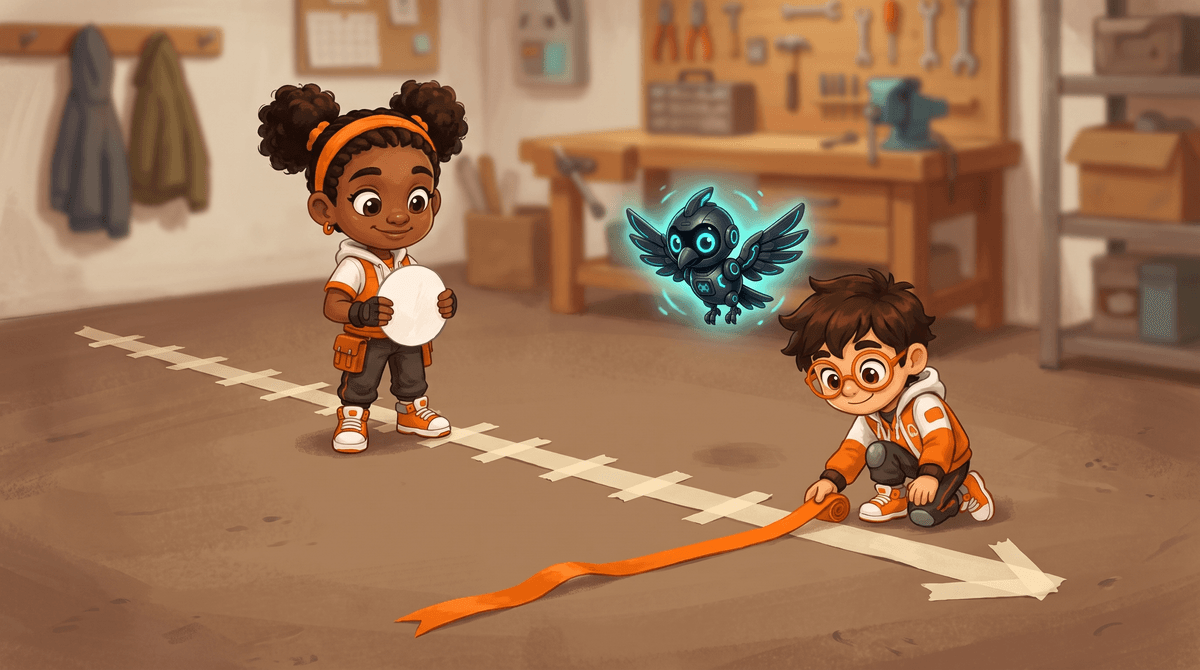
Raven tapes a long strip of masking tape across the garage floor and marks it 0 to 10. "A number line you can walk."
"The puzzle rule says more than 4 cards," Rocket reads. "So the answer is 5?"
"Is it?" Raven asks. "What do you notice if someone brings 6? Or 9?"
"Those are more than 4 too," Rocket says slowly. "So the answer is... all of them?"
Nova hovers above the tape, her light tracing it to the right. "Not one number," she says. "A direction."
Raven sets a paper circle on the 4 and unrolls an orange ribbon from it toward the 10. "x > 4. The ribbon never stops."
Rocket steps onto the 5, then the 7, then off the end. "Infinitely many answers," he says. Nova hums. "Now test one."
An inequality points in a direction
An inequality is a number sentence with >, <, ≥ or ≤. The sign points to the smaller side, so x > 4 says x is more than 4.
An equation like x + 3 = 8 has one solution. An inequality like x > 4 has infinitely many: 5, 6, 4.5, 100, every number above 4.
The number 4 itself is not a solution of x > 4, because 4 is not more than 4. It is the boundary.
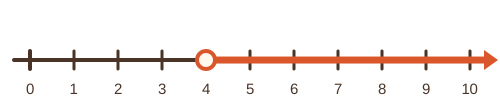
On a number line, draw an open circle at the boundary and an arrow in the direction of the solutions. The arrow never ends.
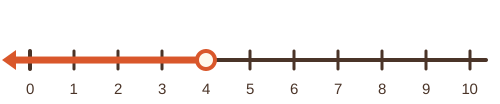
x < 4 points the other way: every number below 4, with the same open circle at 4.
Test a value by substitution
Is 7 a solution of x > 4? Put it in: 7 > 4 is true. Yes.
Is 4 a solution? 4 > 4 is false. The boundary is left out.
Is 2.5 a solution of x < 4? 2.5 < 4 is true. Yes, and so is every number below 4.
- Read the question.
- Tap your answer.
- Read the question.
- Tap your answer.
Which inequality does this number line show?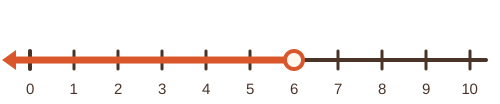 Which inequality does this number line show?
| Statement | True or false? |
|---|---|
| x = 5 makes x > 4 true. | ? |
| x = 4 makes x > 4 true. | ? |
| x = 2.5 makes x < 3 true. | ? |
| x > 4 has exactly one solution. | ? |
Write the inequality it shows. Then list four solutions, including one that is not a whole number.
A direction, not a number. Tomorrow you turn puzzle rules into inequalities and graph them.